Launching a skincare product is relatively easy in theory. Building one that is commercially viable, compliant, well-packaged, scalable, and ready to compete in a crowded beauty market is much harder.
For skincare brands in the United States, Europe, and Australia, choosing a manufacturing location is therefore about much more than comparing unit prices.
You need to consider formulation capabilities, ingredient sourcing, packaging development, product testing, quality control, documentation, production capacity, lead times, communication, and the ability of a manufacturer to support your brand as it grows.
This is why many beauty businesses consider private label skincare manufacturing in China.
China's advantage is not simply "lower-cost manufacturing." Its more important advantage is the combination of skincare formulation, packaging supply chains, manufacturing infrastructure, customization, and production scale within one ecosystem.
But that does not mean every Chinese skincare manufacturer is the right partner for every brand.
This guide looks at China from a brand owner's perspective: where the advantages come from, what risks to evaluate, what compliance issues international brands need to consider, and how to choose a private label skincare manufacturer that fits your business.

Before searching for a skincare manufacturer in China, it helps to clarify what you mean by "private label."
The terms private label, OEM, and ODM are often used differently from one supplier to another, but they generally describe different levels of product development.
| Manufacturing Model | Best Suited For | Typical Level of Customization |
|---|---|---|
| Private Label | Brands that want to launch relatively quickly | Existing or established formula with customized branding and packaging |
| ODM Skincare | Brands with a product concept but without a finished formula | Formula development or modification based on the brand's requirements |
| OEM Skincare | Brands with detailed specifications or proprietary formulas | Manufacturing according to the brand's formula, specifications, or development brief |
For an emerging beauty brand, an established private label formula may provide a lower-risk way to test a category.
For a growing brand trying to create stronger differentiation, customized ODM development may make more sense.
An established company may instead require manufacturing based on its own specifications, test protocols, packaging standards, and quality requirements.
The right Chinese skincare manufacturer should therefore not begin the conversation by asking only:
"How many pieces do you need?"
A more useful discussion begins with:
What market are you selling in, who is the product for, what positioning are you trying to create, and how customized does the product need to be?
One of the biggest advantages of manufacturing skincare in China is the ecosystem surrounding the manufacturer.
A finished serum or moisturizer may look simple on a retail shelf, but bringing it to market can involve many different suppliers:
When these suppliers operate within a mature manufacturing network, coordination becomes easier.
This matters because skincare development rarely happens in a perfectly straight line.
A beautiful bottle may not work with a high-viscosity cream. A pump may dispense too much product. A highly active formula may require different packaging. A decoration technique may push the packaging above the target cost.
The real advantage of an integrated supply chain is therefore not simply having "more suppliers."
It is the ability to solve these interconnected problems faster.
For an overseas brand, a capable Chinese skincare manufacturer can act as the central point connecting formulation, packaging, production, and sourcing rather than leaving the brand to coordinate each supplier independently.
Many new skincare founders assume they need to arrive at a manufacturer with a laboratory-ready formula.
That is not always necessary.
An experienced skincare ODM manufacturer can often begin from a commercial product brief containing information such as:
For example, a brand may know it wants to launch a lightweight barrier serum for sensitive skin but may not know exactly how the humectants, emollients, barrier-support ingredients, preservative system, viscosity, and sensory profile should be balanced.
That is where formulation experience becomes valuable.
The manufacturer's role should not simply be to put fashionable ingredients into a bottle.
Good product development involves balancing:
marketing concept + formulation feasibility + sensory experience + stability + packaging compatibility + target cost
This distinction is important.
A long ingredient list may sound impressive in marketing materials, but the commercial success of a skincare product often depends just as much on texture, absorption, application, fragrance, packaging experience, and repeatability from batch to batch.
Beauty trends move quickly.
Ingredients and concepts such as peptides, ceramides, barrier care, fermented ingredients, retinoid alternatives, sensitive-skin formulas, scalp care, multifunctional serums, and new delivery formats can gain attention rapidly.
However, speed to market should not mean skipping development or testing.
The more meaningful advantage is development efficiency.
When formulation, raw-material sourcing, packaging sourcing, sampling, filling, printing, and assembly can be coordinated within the same manufacturing ecosystem, there are fewer handovers between unrelated suppliers.
That can make product iteration easier.
For example:
Concept → Formula Sample → Feedback → Formula Adjustment → Packaging Selection → Compatibility Review → Production
is much easier to manage when the parties involved can communicate efficiently.
For brands in the US, Europe, and Australia, this can be particularly valuable when your internal team is small and you do not want to build an entire sourcing department simply to launch a skincare line.
Cost is still an important reason brands investigate skincare manufacturing in China.
But evaluating China only in terms of labor costs misses much of the picture.
The final cost of a skincare product includes more than the formula.
It may include:
Formula + Primary Packaging + Decoration + Secondary Packaging + Filling + Assembly + Testing + Freight + Duties + Compliance Costs
A manufacturing region with a large supplier base can offer more ways to engineer this total cost.
Consider packaging.
If one airless bottle pushes your product beyond its target cost, a manufacturer with access to a broad packaging network may be able to recommend another pump system or bottle with a similar visual positioning but a more appropriate cost structure.
The same principle can apply to cartons, printing methods, materials, bottle weights, decoration processes, or formula choices.
For a brand, this means the goal should not be:
"Find me the cheapest factory."
It should be:
"Help me build the best product possible within my commercial target."
Those are very different purchasing strategies.
Packaging is often underestimated when brands initially search for a private label skincare manufacturer.
In reality, packaging can determine how consumers perceive the product before they ever use the formula.
A $60 serum cannot look like a $6 serum.
At the same time, a beautiful custom package that destroys your margin is not commercially useful.
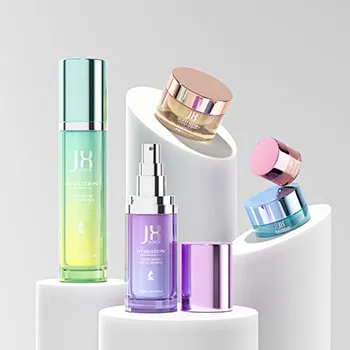
China's cosmetics supply chain gives brands access to a broad variety of packaging formats, including:
This is especially useful for brands building products for visually competitive environments such as DTC websites, Amazon, social commerce, spas, beauty retailers, and specialty stores.
It also creates more flexibility in how a product is positioned.
The same basic category—a facial serum, for example—can be developed for an accessible mass-market brand, a clean minimalist brand, a clinical-inspired line, or a prestige beauty concept largely through changes in formula direction, finish, packaging, and presentation.
Not every new product needs a completely proprietary formula.
For an established brand launching its tenth SKU, full custom development may be justified.
For a startup testing its first product, it may not be.
Using an established private label formula can allow a brand to focus its initial investment on:
If the product gains traction, the brand can then move toward greater customization.
This creates a practical product-development path:
Validated Formula → Customized Version → Exclusive Product Direction → Expanded Product Line
The important point is flexibility.
A manufacturer that supports both private label and custom OEM/ODM development gives a brand more room to change its manufacturing model as the business develops.
Many sourcing conversations start with:
"What is your MOQ?"
It is an important question, but MOQ alone can be misleading.
A skincare project can have several different minimum quantities:
Technically speaking, factories may offer lower Minimum Order Quantities (MOQs)—for instance, the MOQ for existing packaging styles is typically 500 to 1,000 units—though requirements for highly customized bottle designs depend on specific needs.
Brands should therefore ask for the MOQ structure, not simply one MOQ number.
This is particularly important for smaller US, European, and Australian brands because excess packaging inventory can tie up significant working capital.
A useful manufacturing partner should help you understand where minimum quantities come from and suggest alternatives when a packaging concept does not match your launch volume.
One of the best problems a skincare brand can have is unexpectedly high demand.
It can also become a serious operational problem.
Imagine launching 2,000 or 3,000 units of a serum and then discovering that a successful retailer, influencer campaign, or social media post creates demand for tens of thousands more.
Can the manufacturer reproduce the formula consistently?
Can it source the same packaging?
Can raw materials be secured?
Can additional filling capacity be scheduled?
Can batch documentation remain consistent?
A good skincare manufacturing partner should be evaluated not only on its ability to produce your first order but also on its ability to support repeat orders and larger production runs.
For growing brands, scalability is part of product development.
This is one of the most important areas for brands importing skincare from China.
A manufacturer can assist with testing, technical documents, ingredient information, manufacturing records, and regulatory preparation.
But a manufacturer does not remove the brand's regulatory responsibilities in the country where the product will be sold.
Under the US Modernization of Cosmetics Regulation Act of 2022 (MoCRA), cosmetic manufacturing and processing facilities subject to the requirements must register with FDA and renew registration every two years. Responsible persons are also required to list marketed cosmetic products and provide updates as required. FDA specifically notes that facility registration or product listing is not an FDA approval program.
For US brands, this makes it important to discuss documentation and regulatory responsibilities early in the project rather than assuming that the words "FDA registered" automatically make a finished product compliant.
The EU follows Regulation (EC) No 1223/2009.
Cosmetics placed on the EU market require an EU-based Responsible Person. The regulatory framework also includes requirements around cosmetic safety assessment, the Product Information File, manufacturing information, claims substantiation, and notification through the Cosmetic Products Notification Portal (CPNP).
For brands sourcing from China, your manufacturer should therefore be capable of supplying the technical and manufacturing information needed by the professionals responsible for your EU compliance process.
Australia requires a different approach.
Cosmetic ingredients are generally regulated as industrial chemicals through the Australian Industrial Chemicals Introduction Scheme (AICIS). Product purpose, ingredients, and especially the claims made about a product can also affect whether it remains a cosmetic or may fall within the therapeutic-goods framework overseen by the TGA.
This is why a formula should never be developed independently from the marketing claims you plan to make.
A phrase that sounds harmless from a branding perspective can have regulatory implications in the target market.
Be cautious if a supplier tells you:
"Don't worry. This formula is compliant everywhere."
There is no single worldwide cosmetics regulation.
The correct questions are:
Manufacturing and regulatory planning should happen together.
Before choosing a supplier, go beyond product photos and price quotations.
Ask questions that reveal how the manufacturer actually works.
Ask who develops formulas, how samples are adjusted, and whether the technical team can discuss ingredients, texture, stability, and product positioning with you.
Discuss manufacturing standards, incoming raw-material control, in-process checks, finished-product inspection, batch records, and traceability.
Depending on the product and market, you may need to discuss microbiological testing, stability testing, packaging compatibility, specification testing, or additional third-party evaluation.
A factory experienced mainly in domestic production may approach documentation differently from an export-oriented manufacturer working with US, European, and Australian brands.
Tell the supplier your target market at the beginning.
Find out whether you will communicate separately with packaging factories or whether your skincare manufacturer can coordinate bottles, pumps, decoration, cartons, filling, and final assembly.
Sampling is product development.
Ask how revisions are handled, what can be changed, and whether formula, texture, fragrance, appearance, and packaging can be evaluated separately.
Do not evaluate only the first order.
Discuss repeat-order capacity, packaging continuity, raw-material sourcing, lead-time planning, and production scalability.
International manufacturing depends heavily on communication.
A strong supplier should be able to explain why something is technically difficult, why a price changes, why an MOQ exists, or why a requested claim or ingredient requires additional review.
You should be looking for a manufacturing partner that solves problems—not one that simply says yes to everything.
At Xiran Skincare, we work with international skincare brands through private label, OEM, and ODM manufacturing models.
Our role is not simply to fill a customer's logo onto an existing bottle.
Depending on the project, brands can begin with an existing formula for a faster private label route or work with our R&D team on customized formulation and product development.
Xiran Skincare's public manufacturing information describes support across formula development, existing formula options, custom packaging, sampling, production, quality control, export documentation, and international shipping. The company also lists an in-house laboratory/R&D team and GMPC/ISO 22716-related manufacturing credentials among its capabilities.
This allows us to approach a project as a finished-product system rather than treating the formula and package as separate decisions.
For example, if you are developing a facial serum, the conversation can include:
Xiran Skincare also publicly offers both custom formulation and private label routes, together with packaging coordination and sample development, allowing brands to choose a development model based on their budget, timeline, and desired level of differentiation.
For brands entering markets such as the US or EU, Xiran Skincare also lists support for export-related documents including COA, MSDS and assistance with documentation processes such as CPNP, CPSR and PIF. These services should be understood as regulatory support and documentation assistance, rather than a substitute for the brand's own legal or Responsible Person obligations in its target market.
If you want a meaningful quotation, avoid sending only:
"How much for private label serum?"
Instead, prepare a short product brief containing:
You do not need to have every answer.
In fact, part of the manufacturer's job should be helping you translate a commercial idea into a realistic product specification.
But the more your manufacturer understands your market and positioning, the more useful its recommendations will be.
China may be a particularly good manufacturing option when your brand values:
However, China may not be the right answer if your priority is simply geographic proximity to your home market, extremely small handmade production runs, or a manufacturing-origin story specifically tied to another country.
The decision should fit your brand strategy.
The best reason to choose private label skincare manufacturing in China is not that China is cheaper.
It is that the right manufacturing partner can give a brand access to an interconnected system of:
R&D + Formulation + Ingredients + Packaging + Production + Quality Control + Export Support + Scale
That combination can be powerful for skincare brands in the United States, Europe, Australia, and other international markets.
But country of origin alone does not determine whether a project succeeds.
The manufacturer still needs to understand your product, your consumer, your target market, your quality expectations, and your commercial goals.
At Xiran Skincare, we believe the most productive manufacturing conversations start before a brand asks for a final quotation.
Tell us what you are trying to create, where you plan to sell it, how you want the consumer to experience it, and what commercial parameters you need to work within.
From there, we can help you evaluate the most practical route—from private label and formula customization to packaging coordination and scalable production.
Planning a new skincare line?
Send Xiran your product concept, target market, estimated quantity, packaging direction, and target positioning to start discussing a private label or custom OEM/ODM skincare project.
Beauty brands often choose China because its cosmetics manufacturing hubs combine formula development, packaging sourcing, filling, decoration, quality control and export coordination within a relatively concentrated supply chain.
The advantage is therefore not simply a lower unit price. For brands developing several products, having formula laboratories, bottle suppliers, printers, carton manufacturers and filling factories within the same manufacturing ecosystem can reduce coordination work and make packaging customization easier.
For a global beauty brand, China tends to be most attractive when MOQ flexibility, product variety, packaging choice and speed to market are important.
It can be, but country of origin alone does not determine product quality.
A reliable manufacturer should be able to show its manufacturing standards, quality-control procedures, raw-material records, batch documentation and relevant testing. Depending on the product, brands should discuss microbiological testing, stability testing, preservative efficacy and packaging compatibility.
The more useful question is therefore not:
“Are Chinese skincare products safe?”
but:
“Can this specific factory prove how it controls formula, raw materials, production and finished-product quality?”
Current manufacturer examples commonly place standard private label skincare around 500–3,000 units per SKU, while fully customized OEM formulas or specialized packaging can require higher quantities. For example, some factories publish 1,000 units as a first-run starting point, while others use 3,000 units for normal production and offer smaller trial quantities.
Packaging can change the number significantly.
A standard bottle may work at 1,000 units while a custom-colored pump, molded bottle or special decoration requires several thousand pieces.
Current sourcing guides place basic China-made skincare products roughly in the $1.50–$8 per unit range for certain 500–2,000-unit projects, although premium actives, testing and customized packaging can move the cost considerably higher. Treat this as a broad sourcing reference rather than a factory quotation.
When comparing quotations, ask suppliers to separate:
formula/product + packaging + customization + testing + freight.
A factory with the lowest unit price is not always the lowest-cost launch.
This is one of the most important questions because search results and B2B platforms can contain both manufacturers and trading companies.
Before paying for development or production, verify:
Several current China OEM guides specifically warn buyers to distinguish a real ODM factory from a reseller that must send every technical question to another supplier.
A factory audit—onsite or by an independent third party—is preferable for larger projects.
Yes, and this is one of the main reasons global brands source cosmetics in China.
Manufacturers can usually coordinate standard bottles and jars as well as:
However, the packaging MOQ is often different from the formula MOQ.
For a startup, stock packaging with customized labels or cartons is often the easiest way to keep the first order manageable. More proprietary packaging can be introduced after sales justify the higher component minimums.
Yes. Cosmetics do not have to be manufactured locally to be sold in those markets, but the finished product must comply with the requirements of the destination market.
For the United States, MoCRA includes cosmetic facility-registration and product-listing obligations for applicable companies. FDA also explicitly notes that facility registration or product listing is not product approval.
For the EU, imported cosmetics require an EU-established Responsible Person and must meet Regulation (EC) No 1223/2009, including applicable safety and documentation requirements.
For Great Britain, cosmetics require a UK Responsible Person, a PIF and notification through the UK's cosmetic notification system before being placed on the market.
A good Chinese manufacturer can supply technical and manufacturing documentation, but the brand/importer remains responsible for ensuring local compliance.
A ready-made private label formula can move relatively quickly because the formulation stage has already been completed. Custom development takes longer because it may involve samples, revisions, stability work, packaging compatibility and component sourcing.
Current industry examples range from roughly 25–45 days for straightforward production after approvals, while a completely new SKU can take several months from concept through landed inventory.