Volufiline is a beauty ingredient for plumping and volume-based skin care. It contains Anemarrhena asphodeloides root extract and is associated with a plant compound sarsasapogenin. In the laboratory sarsasapogenin appears to affect fat cell differentiation and lipid storage . However, there is still little credible evidence in humans for significant facial volume increase .
If you’ve first heard about Volufiline on TikTok, Reddit or a skincare forum, you’ve probably seen much bigger promises than that.
Look hard enough and Volufiline is branded a “natural face plumper” or “filler in a bottle.” Before-and-after photos tend to highlight under-eye hollows, cheeks, smile lines, and lips. Some even repeat one very specific number: 8.4% more volume after 56 days.
That number is legit.
But the way it is often told leaves a lot out of the story.
I got a lot more interested in Volufiline when I stopped listening to marketing claims, and went back to the ingredient supplier, and the underlying patent, and the actual experimental numbers. What I found is more nuanced than either “Volufiline definitely grows facial fat” or “Volufiline is just hype.” And more interesting, I think.
There is a reasonable scientific concept behind the component. There are lab results that are worth looking at. There are human tests too. At the same time, there is no evidence to date to support the use of Volufiline as a topical injectable filler replacement.
Here’s what we’ve learned.

The easiest way to understand this Volufiline is:
Volufiline is an oil soluble cosmetic active designed for use in cosmetic products that desire to give areas of skin a fuller or plumper appearance.
It was created by Sederma, now part of Croda Beauty. Volufiline, information from Croda says, has been used in beauty applications for years and is now gaining renewed interest in facial skincare and visible volume loss concerns.
This last is more important than it sounds.
When you buy a “Volufiline serum” you are not buying a bottle of pure Volufiline or pure sarsasapogenin. You are buying a finished formulation that contains Volufiline, among other ingredients, added by a manufacturer.
The INCI as approved by the official:
Hydrogenated Polyisobutene, Anemarrhenae Asphodeloides (Root) Extract
Therefore, there are two things worth knowing.
The base of raw material is oil-like hydrogenated polyisobutene. The botanical part is Anemarrhena asphodeloides, which is a plant that contains many naturally occurring compounds. One of the compounds most closely linked to the Volufiline story is sarsasapogenin.
Sarsasapogenin is a naturally occurring steroidal sapogenin mainly from Anemarrhena asphodeloides. A PubMed-indexed scientific review on the chemistry and pharmacology of sarsasapogenin confirms its botanical origin, and reviews the larger body of research on the molecule. But much of the research is on biological activities that have nothing to do with cosmetic facial plumping.
So there is an important difference:
Volufiline is not just another name for pure sarsasapogenin.
Volufiline is the commercial cosmetic raw material, The suggested mechanism involves certain plant derived compounds such as sarsasapogenin.
This also means that the label “5% Volufiline” on a serum should not be interpreted as a simple indication of 5% pure sarsasapogenin.
For shoppers hunting for products, it’s an easy detail to miss.
The volufiline itself isn't new.
What is new is the attention paid to the loss of facial volume.
Croda said Volufiline had been on the market for years but was experiencing renewed interest as consumers sought out non-invasive options for dealing with areas that seem to lose volume with age. The company also pointed to new opportunities in facial skincare in particular.
That’s understandable given the current conversations about skincare.
Consumers are not just interested in fine lines and pigmentation anymore. More and more talk about hollow under eyes, flatter cheeks, facial fat loss and how facial contours change with age or significant weight loss.
Volufiline fits nicely into that conversation as it doesn’t play the typical “hydrate the skin and make it look plumper temporarily” story.
It has a different mode of action.
And this is what really makes the ingredient interesting.
Most people already know that a hydrating serum can make their skin look more plump.
Less water in dry skin can make fine lines more prominent. Add humectants like glycerin or hyaluronic acid, improve hydration and the surface can look smoother and plumper.

Volufiline is not marketed around water.
It is meant for adipocytes, the cells that store fat.
You don’t have to know cell biology to get the basic idea.
Fat tissue under the skin helps to provide softness, shape and volume to various parts of the face. The theory behind Volufiline is that sarsasapogenin may stimulate the growth of fat cells and may increase the storage of lipids in mature adipocytes.
In very simple words:
Volufiline → sarsasapogenin → activity of fat cells → increased lipid storage → possible increase in tissue fullness
The first link in this chain is supported by experimental evidence.
The last part, especially when we’re talking about noticeable changes in a person’s cheeks, tear troughs or lips, is where we need to be a lot more careful.
This is where Volufiline has more science backing it than many viral skincare ingredients.
The original Sederma patent describing compositions comprising sarsasapogenin reports experiments with 3T3-L1 cells, a model frequently used for the study of adipocytes development [ 7 ].
Researchers measured a marker called G3PDH, which rises as these cells become mature fat-storing adipocytes.
You don't have to remember the name of the enzyme really . But the useful part is the pattern researchers saw.
The adipocyte-differentiation marker was increased with the sarsasapogenin concentration.
| Sarsasapogenin | Change in G3PDH activity vs. untreated cells |
|---|---|
| 5 μM | +103% |
| 10 μM | +201% |
| 15 μM | +429% |
| 17.5 μM | +535% |
All four concentrations were reported at p < 0.01.
That’s interesting because the answer wasn’t random. Increased with concentration.
The researchers then measured how much lipid accumulated inside the cells.
Compared to untreated control cells, lipid accumulation increased by:
| Sarsasapogenin | Change in measured lipid accumulation |
|---|---|
| 5 μM | +135% |
| 10 μM | +274% |
| 17.5 μM | +492% |
The patent also included replicating the lipid-uptake results in human adipocytes.
Those are big figures.
They are also some of the easiest Volufiline figures to get wrong.
No.
This experiment does not mean that a person’s cheek, lip or under-eye fat will increase by 492%.
The researchers were measuring the build up of lipids in cells in a controlled laboratory setting. Sarsasapogenin was added to the cells directly at a defined concentration.
That is very different from applying a serum to intact human skin.”
A topical ingredient has to work in a finished formula, penetrate the skin barrier as far as possible, reach biologically relevant tissue and be present there in a useful concentration.
So I think these experiments are good evidence for a potential mechanism.”
I don’t see them as proof of a 492% increase in facial volume.That distinction is important when evaluating Volufiline claims.
This is probably the one Volufiline claim I’d fact-check before any other.
You’ve likely seen it:
“Volufiline increased volume 8.4% in 56 days.
The number does appear in the patent underlying the patent.
But 8.4% was not the average of the whole study group.
The study population consisted of 32 women aged 18-35 years. Thirty patients completed the study and 28 were evaluable at day 56. The test product was applied twice daily for 56 days to one breast, with the opposite breast serving as an untreated control.
The average findings were:
| Time | Treated side | Untreated side |
|---|---|---|
| 28 days | +1.4% | -0.1% |
| 56 days | +2.2% | +0.9% |
However, the results were as follows for the eight best responders:
| Time | Treated side | Untreated side |
|---|---|---|
| 28 days | +6.6% | -6.4% |
| 56 days | +8.4% | -2.0% |
Yeah, there’s 8.4% in the data.
But it is the subgroup of the eight best responders—not the average change across 28 evaluable subjects.
The mean increase on the treated side after 56 days was 2.2%.
That’s a much more useful number to know.
There is another piece of context that gets left out a lot. The treated side at Day 56 was reported with a p-value of p = 0.10 The patent called this a 90% certainty, but it would not cross the conventional threshold for statistical significance under the widely used p < 0.05 convention.
That doesn’t make the study worthless.
It just changes what can be reasonably inferred from it.
The human data suggest the possibility of a modest volume effect, with some people apparently responding more strongly than others. They do not indicate that every user should expect to see an increase of 8.4%.
There Is a Bigger Catch Yet: This Was Not a Facial Study
This is the part I think consumers should focus on the most.
The human test above measured breast volume, not volume of the cheeks, lips or tear-trough.
This is important because body areas can’t be replaced.
The breast tissue is very different in structure and fat distribution from cheek tissue or lip anatomy or the under eye region.
But now the 8.4 percent figure is frequently used in content about:
The study does not directly prove that those outcomes.
Croda is clearly interested in newer facial applications and reports a renewed commercial interest in facial skincare applications.
But that’s not the same as a big, independent study showing an increase in facial volume by a certain percentage.
We should retain that distinction.
Looking at the evidence, I would split the answer into 3 levels.

Sarsasapogenin may modulate adipocytes differentiation and lipids accumulation in experimental cell models. The patent experiments showed an increasing effect with concentration.
In a small controlled study, the average increase of measured volume on the treated side was reported after 56 days. The average was 2.2%, and the eight strongest responders averaged 8.4%.
We don’t have similar data to say that the average person applying a Volufiline serum to the under-eye area, cheeks or lips will create a predictable amount of new facial volume.
Which brings me to a far more useful conclusion than just calling Volufiline “proven” or “unproven”:
Volufiline is interesting; it has a promising mechanism and promising preliminary data – but the facial claims floating around the internet are ahead of the best available human evidence.
That, to me, is the most fair reading of the science.
When the evidence is placed in context, it is easier to discuss realistic Volufiline benefits.
This is the main reason why people are interested in the ingredient.
Volufiline is not your typical hydrating serum because it is positioned close to adipose tissue and the look of volume. Croda, at the moment, describes the ingredient in terms of visible plumping and areas where volume is lost with age.
The mechanism is believable.
It’s unclear how big or consistent the visible effect on facial skin will be.
So I’d expect subtle improvement, if it happens, rather than the dramatic structural change we see in many social-media transformations.
Hence the interest in using Volufiline around the cheeks and under the eyes.
Even slight changes to the fullness of the face can change the way light hits the face, and can create the illusion of an area being softer or less hollow.
But there is more than one reason for “hollowness.”
The anatomy of the face, skin thickness, pigmentation, visible blood vessels, fat distribution or the shape of the tear trough can influence under-eye shadows, for example.
There is no reasonable expectation that Volufiline will cure all of those problems.
There is another benefit, far less exciting but well worth remembering.
The finished Volufiline product contains more than just the active ingredient.
Hydrogenated polyisobutene has an emollient feel and Volufiline serums are often formulated with other moisturisers, oils or humectants.
Which means that some of the immediate softness or smoothness you see after you apply it might be due to increased moisturization and emollience, not newly increased tissue volume.
I would keep in mind if a before and after photo was taken after 3 days.
I would steer clear of that phrase.
As per the U.S. the FDA’s guidance on dermal fillers states that dermal fillers are injectable medical devices placed into tissue for specific approved indications, such as augmentation of areas such as the lips and cheeks.
Volufiline is used in topical.
Those approaches are very different.
A filler injects material directly into tissue. Volufiline employs a cosmetic formulation that interacts with the skin and may affect biological processes over time.
The phrase “filler in a bottle” may be catchy marketing, but it invites a comparison that the evidence does not support.
I also don’t see Volufiline and hyaluronic acid as competing versions of the same thing.
They are trying to create a plumper look, but by very different means.
| Ingredient | Main idea | Why skin may look plumper |
|---|---|---|
| Volufiline | Volume-focused active | Proposed influence on adipocyte differentiation and lipid storage |
| Hyaluronic acid | Hydration | Helps retain water and improve surface hydration |
| Peptides | Skin signaling/support | Depends heavily on the specific peptide |
| Retinoids | Long-term skin remodeling | Support established pathways involved in photoaging and skin renewal |
That’s why I think it makes more sense to combine Volufiline with hydrating or skin-supporting ingredients rather than assume Volufiline needs to work alone.
A good product might address several different aspects of the appearance of ageing at the same time, such as hydration, fine lines, barrier quality and the look of lost volume.
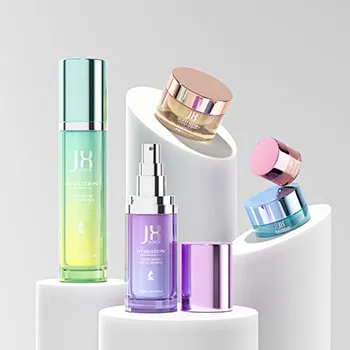
XIRAN’s 3% Volufiline Spherical Peptide Firming Serum is one example of this multi-active strategy, featuring a Volufiline positioning blended with peptides, hydration and barrier-supporting ingredients.
This is probably the facial use that gets the most attention.
And it’s one area where I’d keep expectations especially realistic.
Now, Volufiline is being added to specially formulated formulas to plump the eye area. XIRAN has developed a 5% Volufiline Peptide Plumping Eye Cream, which contains a combination of Volufiline, peptides, caffeine and other eye-care actives.
What we still need to separate is: “The ingredient can be formulated for under the eye area”
from: “Clinical research shows it replaces a certain amount of under-eye fat.”
Those two claims are not the same.
If I was testing an eye product with Volufiline I would take baseline photos under similar lighting and compare over several weeks. "I wouldn't judge the result from a few days of use or from pictures taken under different lighting.
The under-eye area makes a huge difference with shadows.
The same warning here, too.
Lip products can certainly help make lips look more full by hydrating, smoothing and improving surface condition.
What the above evidence has failed to demonstrate is predictable lip augmentation from Volufiline that is comparable to injected lip filler.
So I'd be wary of grandiose statements such as:
“Grow your lips naturally.
or
“Swap out lip filler for Volufiline.
Those comments are far beyond what the existing data supports.
If the potential effect hinges on changes in adipocyte activity, I wouldn’t expect to see any meaningful biological results overnight.
The human experiment revealed in the patent measured subjects at 28 days and 56 days, with the larger average difference observed at Day 56.
That provides a more sensible way of evaluating a product .
Think in terms of weeks, not days.
To try it yourself I would compare consistent photos at:
That’s not to say everyone will see results by eight weeks.
That simply makes a fairer test than the decision after five applications.
We have no good evidence for permanent changes in facial volume after stopping Volufiline.
That should raise eyebrows for anyone hearing claims about a topical fat-transfer effect that lasts.
Normal facial fat and soft tissue changes over time due to age, body weight, hormones and other biological factors.
I would think any visible effect from Volufiline would be something that might need to be maintained at this point, rather than assuming it changes facial structure for good.
In the patent study, the test product was well tolerated by participants over the 56 day period.
That is reassuring, but should not be taken as a complete long-term safety database.
Here I’d like to draw a further distinction, one that’s become increasingly relevant as Volufiline has become more popular online:
a raw material for cosmetics and a finished consumer serum are two different things.
Usually, a raw cosmetic active is intended for use in a properly formulated finished product.
So I'd go for a properly formulated finished product rather than buying a raw cosmetic ingredient because it sounds stronger with a higher concentration.
Higher isn't necessarily better.
And if a product is going near the eyes or on the lips, it makes even more sense to go for something made for that area.
I'm not reading the percentage on the front of the bottle.
Start with the full formula.
To achieve visible plumping, ingredients like glycerin, hyaluronic acid, barrier-supporting lipids and selected peptides may improve the formula by targeting hydration and overall skin quality, while Volufiline provides the volume-focused positioning.
Consumers who want to compare different serum formats can also consider how a manufacturer approaches private label facial serum development, where formula structure, supporting actives and target skin concerns can vary considerably from one serum concept to another.
I would also look for a brand that explains what their percentage is.
Remember:
5% Volufiline is not equivalent to 5% pure sarsasapogenin.
Volufiline is a cosmetic active which is formulated with Hydrogenated Polyisobutene and Anemarrhenae Asphodeloides Root Extract.
That means a larger number on the label doesn't necessarily indicate that one serum provides five or ten times as much biologically active sarsasapogenin as another.
Quality of formula still matters.
And this is where I think the Volufiline story becomes really interesting.
The cell studies give scientists reason to continue looking.
The human data give us a signal that is worth exploring.
It would be much stronger if the evidence were based on a well-designed facial study that mirrors how people actually use the ingredient today.
I want to see:
Such a study could answer questions that TikTok before-and-after photos can’t.
Until then, nothing wrong with being interested in volufiline.
There is just a difference between promising science and proof positive.
I think Volufiline is more interesting than just slapping another trending ingredient on a label for skincare brands.
Consumer attention is clearly increasing. Croda said that Volufiline had opened up new avenues in facial skincare in 2026, highlighting the ingredient’s re-ignited commercial momentum.
Our guide to Volufiline skincare manufacturers can also help beauty brands actively assessing suppliers compare the types of companies currently working with the ingredient.
But the opportunity has a positioning problem.
I wouldn’t build a Volufiline product on over the top “topical filler” claims.
I would start with what the real problem is that the product is supposed to solve.
For example:
The wording is as important as the formula.
Cosmetic appearance is described as “helps skin look fuller” and “improves the appearance of lost volume.”
“Regrows facial fat” or “replaces dermal filler” is a much stronger claim not supported by the available evidence.
This is especially important for brands selling into markets with defined cosmetic-claim requirements. EU Commission Regulation No. 655/2013 on cosmetic claims states that cosmetic claims should be substantiated with adequate and verifiable evidence and that ingredient properties should not be automatically presented as finished product performance without appropriate substantiation.
A good example is one from our own product development materials. Third party tests of our 5% Volufiline face cream after 28 days of continuous use with 33 participants are summarised in XIRAN’s Volufiline presentation, page 34. Reported changes include 47.6% increase in skin hydration, 27.7% increase in the R2 elasticity parameter and 22.7% decrease in skin roughness.
I add this example because it shows why the measured question is important. These are results reported for a ready-made cream with a mixture of ingredients, not a test of Volufiline by itself. Improvements in hydration, elasticity and surface texture should not be interpreted as measures of new facial fat or restored tissue volume .
The link is a summary of results, not the actual laboratory report. Its value here, to me, is to show the difference between an ingredient story and product-specific proof. Any stronger conclusion would require the full study methods and analysis, not just the percentages.
And here I come out after stripping the social-media claims away.
The mechanism is based on hard science.
In laboratory experiments, sarsasapogenin altered markers of adipocyte differentiation and lipid accumulation in a dose-dependent manner.
There is some human evidence.
A Sederma patent reports 28 evaluable subjects with an average 2.2% increase in measured treated-side breast volume after 56 days.
The notorious 8.4% figure needs to be seen in context.
The mean was for the eight strongest responders, not the entire group.
The facial evidence is much more fragmentary.
The often quoted human volume study was performed on breast tissue, not cheeks, lips, or under eye area.
So I’d call Volufiline a promising, not proven, facial volumizer.”
That may not be as exciting as “filler in a bottle.”
But I think it’s a better story actually.
There aren’t a lot of trending skincare ingredients that have a mechanism interesting enough to be talked about this much. Volufiline does. What it needs now is better facial clinical evidence to catch up with the pace of consumer interest.
I don’t think Volufiline should be dismissed as just another useless TikTok ingredient. The adipocyte research provides a plausible biological basis and the existing human data are interesting enough to warrant further investigation.
I also would not purchase a Volufiline serum expecting it to replicate injectable filler.
As a consumer, I would consider this an ingredient worth trying if you are searching for subtle, non-invasive plumping and are prepared to give it several weeks rather than several days.
For beauty brands, the opportunity may be even greater: build Volufiline products around real consumer needs, combine the ingredient smartly with complementary actives and generate evidence on the finished formula rather than relying entirely on an old 8.4% headline.
That is the direction that could turn Volufiline from a viral skincare ingredient into a much more credible long-term category.
No. Volufiline is a formulated cosmetic raw material containing Hydrogenated Polyisobutene and Anemarrhenae Asphodeloides Root Extract. A formula containing 5% Volufiline therefore does not contain 5% pure sarsasapogenin.
Not necessarily. More raw material does not automatically mean a better-performing finished product. Delivery system, supporting ingredients, stability, skin feel and the amount of sarsasapogenin actually present all matter. A well-designed lower-percentage formula may be more useful than a poorly formulated product advertising a much larger number.
Yes. Hyaluronic acid primarily supports hydration and temporary surface plumping, while Volufiline is positioned around a different volume-focused mechanism. Using both in the same routine or formulation can therefore make sense when the goal is to improve both hydration and the appearance of fullness.
Yes. Volufiline and peptides target different aspects of skin appearance, so they are often considered complementary rather than competing ingredients. A volume-focused formula may combine Volufiline with peptides, humectants and barrier-support ingredients to address fullness, hydration and the appearance of fine lines at the same time.
The amount of Volufiline used in a finished cosmetic depends on the product concept, supplier guidance and overall formulation. A percentage shown on a product label usually refers to the Volufiline commercial raw material, not pure sarsasapogenin. This is why comparing two products only by the percentage printed on the front can be misleading.
At minimum, I would look at formula stability, packaging compatibility, microbiological safety where relevant and finished-product performance. If the brand plans to make visible plumping or volume-related claims, standardized photography, consumer testing or instrumental measurements can provide much more meaningful support than simply repeating supplier data.