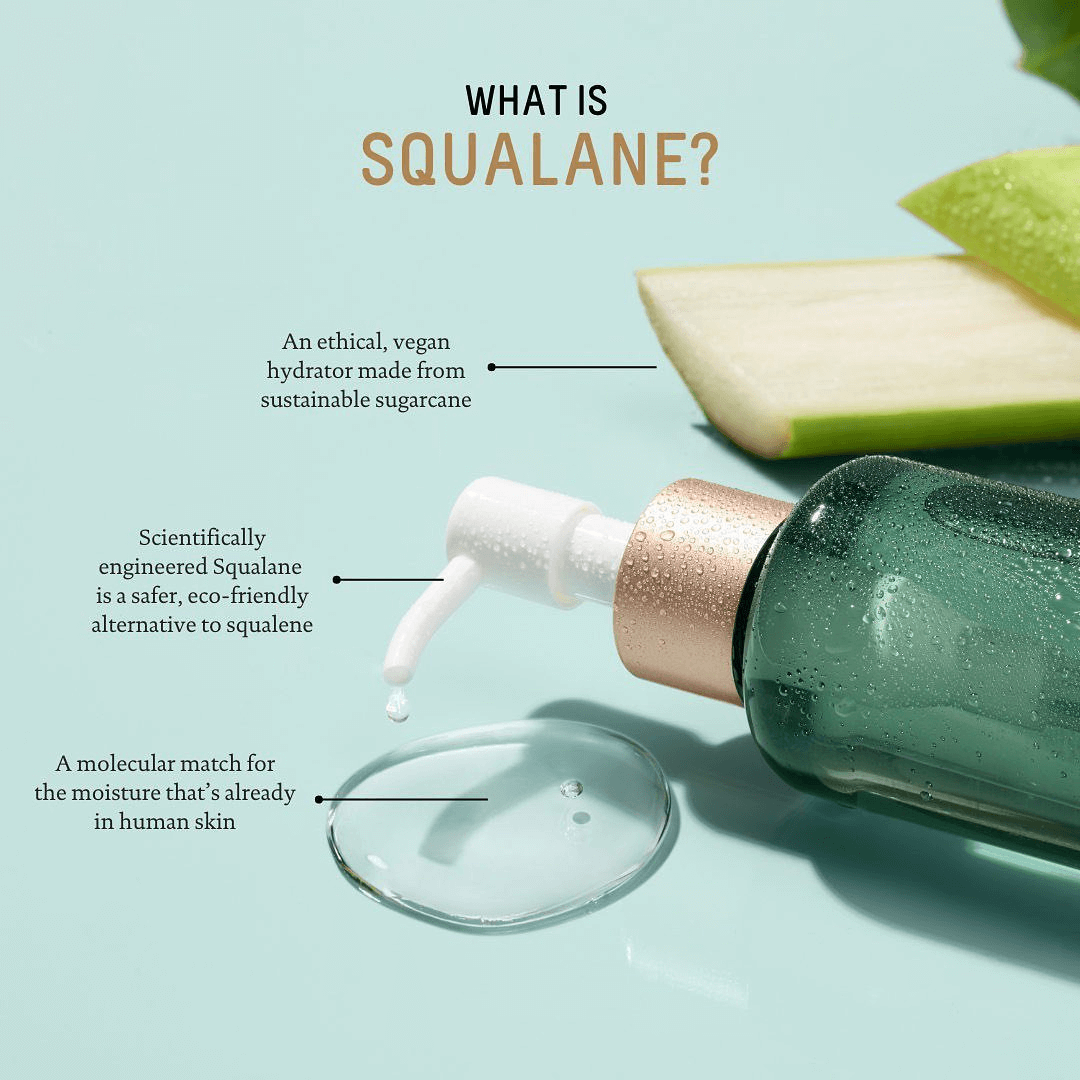
Squalane is one of those ingredients that looks deceptively simple on an ingredients list, yet can do surprisingly useful work in skincare and haircare.
It’s called a “hydrating oil,” a “anti-aging ingredient,” a “hair repair oil” or even a hair-growth ingredient. Some of those descriptions have a kernel of truth, but they also make squalane sound more complex—and more powerful—than it really is.
“From a formulation standpoint, I think of squalane first as a lightweight, stable emollient. On skin, it might help soften rough texture, improve the way dry skin feels and support moisture retention. On the hair it can help improve lubrication, softness, shine and manageability without necessarily leaving the heavy finish that is associated with some richer oils.
That's an important distinction.
It’s so much easier to decide if squalane for skincare, squalane for hair or a product that combines it with other ingredients is right for you, when you understand what squalane actually does.
Squalane is a lightweight emollient that helps to soften skin, lessen the dry feeling caused by moisture loss, and lends a smooth, silky texture to skincare products. On hair, squalane can coat and lubricate the hair’s surface, helping dry or rough strands feel softer, smoother and easier to manage. But it’s not a documented hair-growth treatment.
Squalane and squalene are very similar, but I don't think they are interchangeable ingredients when I am looking at a cosmetic formula.
Squalene is a naturally occurring lipid present in human sebum and in a number of natural sources. Squalene, a primary constituent of human sebum, and its saturated derivative, squalane, are discussed in a scientific review in Advances in Food and Nutrition Research.
The operative word here is saturated.
Squalene has unsaturated bonds and is therefore more prone to oxidation. Squalane is made by hydrogenating squalene, making it more resistant to oxidation and easier to use in finished cosmetic products.
This is part of the reason why I usually consider squalane to be the cosmetic-friendly cousin of squalene.
And the difference is also why it can be misleading to look at an ingredient just through the lens of it being “similar to natural sebum”. Your skin produces squalene naturally. But the bottle of squalane oil that’s part of a skincare routine isn’t just bottled human sebum.
These are chemically related materials with different stability characteristics .
Squalane and squalene are very similar, but I don't think they are interchangeable ingredients when I am looking at a cosmetic formula.
Squalene is a naturally occurring lipid present in human sebum and in a number of natural sources. Squalene, a primary constituent of human sebum, and its saturated derivative, squalane, are discussed in a scientific review in Advances in Food and Nutrition Research.
The operative word here is saturated.
Squalene has unsaturated bonds and is therefore more prone to oxidation. Squalane is made by hydrogenating squalene, making it more resistant to oxidation and easier to use in finished cosmetic products.
This is part of the reason why I usually consider squalane to be the cosmetic-friendly cousin of squalene.
And the difference is also why it can be misleading to look at an ingredient just through the lens of it being “similar to natural sebum”. Your skin produces squalene naturally. But the bottle of squalane oil that’s part of a skincare routine isn’t just bottled human sebum.
These are chemically related materials with different stability characteristics .
On this one we have relatively strong regulatory safety information.
The Expert Panel on Cosmetic Ingredient Safety reviewed new data on squalane and squalene and reaffirmed that these ingredients are safe in cosmetics when used as described in its assessment of the conditions of use and concentrations. The updated assessment was published in 2023 in the International Journal of Toxicology.

That doesn’t mean all squalane products will work for everyone, though.
The safety of an individual cosmetic ingredient is one thing; the compatibility of a full finished formula is another. A person's skin can react to fragrance, botanical extracts, preservatives, surfactants, active ingredients, and even how a product is used.
That’s why I prefer to look at squalane in relation to the entire formula, rather than judging a product on just one ingredient as a promise of gentleness.
If I had to define squalane for skincare in one sentence then I’d say it’s a sensory friendly emollient.
This may not sound as exciting as “deep hydration” or “anti-aging miracle oil,” but this is actually why squalane is so helpful.
An emollient helps to soften and smooth the outer layer of the skin. That’s why modern moisturiser science tends to classify moisturising ingredients as humectants, emollients, and occlusives—they don’t all treat water the same way. In reviews of skin-barrier moisturization, emollients are described as interacting ingredients within the stratum corneum that contribute to enhanced softness and barrier support.
This is why I wouldn’t describe squalane the same way I would describe glycerin or hyaluronic acid.
A humectant is primarily for attracting and/or retaining water. Squalane acts much more like a lipid.
This is because the outer skin barrier isn’t retaining moisture as well as we’d like, which is why dry skin often feels rough, tight or uncomfortable.
Adding an emollient such as squalane can help improve the surface feel of the skin, fill some of the gaps around dry skin cells and leave the skin feeling smoother.
This is also why a few drops of squalane can transform a moisturiser into a noticeably richer consistency without turning it into a thick balm.
I find this very useful in formulation work when a brand wants to provide moisturization and softness but doesn’t want the consumer to think of the product as greasy or waxy after feel.
This is where the wording comes in.
I'd prefer to say:
“[Squalane] helps to trap in moisture and reduce the feeling of dryness.
than:
Squalane provides deep hydration to every layer of skin.
The second statement implies much more than the evidence warrants.
Studies have shown that well-formulated emollient systems can improve skin hydration and help control transepidermal water loss in studies of moisturisers.
But how a moisturiser works depends on the entire formulation – not just one trendy ingredient.
This is how I do formulation at XIRAN too. When we make a moisturiser through our, I’m interested in how the humectants, emollients, emulsifiers, occlusives and actives all work together, rather than trying to make one ingredient carry the entire marketing story.
The gain is less spectacular—yet commercially significant.
Consumers are judging skincare before they understand the science of the ingredients.
They observe if a serum flows freely. They check to see if a facial oil is sticky. They check whether a moisturiser is absorbed properly or leaves an oily film for the next half hour.
Another benefit is that squalane contributes a silky, smooth sensory profile to many formulas. That’s what makes it especially interesting in facial oils, moisturisers, serums, eye products and barrier-focused formulas.
This is why I see squalane as a texture designing tool and a functional ingredient for brands developing these categories.
Our product range includes formats such as face creams, serums and face oils where the choice of emollient can have a major impact on the feel of the finished product.
Probably the simplest use case to understand is dry skin.
If your skin is not soft, and feels rough or tight, squalane can help to make the surface more comfortable and supple.
I love the idea of combining squalane with other ingredients that work differently, rather than just using it alone. A formula might combine a humectant, like glycerin, with squalane and other lipids so the product addresses water retention and surface softness through more than one mechanism.
But for very dry skin, pure squalane still may not be quite as protective as a richer cream or balm with more occlusive ingredients.
So I would choose the product format, not just the hero ingredient, based on the actual dryness of the skin.
Oily, yes, often—but “oily” does not equal “doesn’t need emollients.”
Some with oily skin choose squalane because it’s lighter on the skin than heavier oils.
But I also wouldn’t tell someone with oily skin that a squalane product is a sure-fire non-greasy or non-comedogenic thing.
A completed facial oil that is primarily squalane will act different than a cream that combines squalane with a number of richer emollients, waxes and esters.
If oiliness is a concern for you, I would start by looking for a lightweight formulation, and consider the presence of squalane as one useful characteristic, but not the whole decision.
This is a question that deserves more nuance than “squalane doesn’t clog pores.”
Squalane has a good history of use in cosmetics and the CIR assessment supports its safety under current conditions of cosmetic use. But ingredient safety doesn’t mean that every squalane product will be non-comedogenic for every person.
In discussing acne it is also worth distinguishing squalane from squalene. Research has been done on natural skin squalene and its oxidation products and their role in comedogenesis. That doesn’t mean cosmetic squalane acts the same way. The difference in chemical stability is huge.
For acne-prone consumers, my practical advice is simple: look at the entire formulation and ease into new leave-on products.
Squalane is also often found in minimalist formulas and in formulas targeting sensitive skin because it can add emollience without needing an extremely complex ingredient system.
But I don’t use the words “suitable for all sensitive skins”.

Many factors can affect sensitive skin. Someone may tolerate squalane perfectly, but react to the fragrance, preservative system, botanical extracts or active ingredients in the same formula.
So I take a full ingredient deck approach to sensitive skin positioning, rather than just seeing if squalane is high up on the list.
That’s where things get more interesting, because squalane for hair is often talked about in skin-care terms.
Hair is not skin.
What we see as the hair shaft is a fibre and improving its cosmetic condition is very much a function of surface chemistry, friction, lubrication and previous damage.
A systematic review of human hair lipids states that lipids influence characteristics such as hydration, strength, and texture, but chemical treatments, surfactants, environmental exposure, and ageing can lead to lipid loss and hair damage.
This puts us in a much better position to understand squalane in haircare.
The first thing I look for in a hair oil or serum is not whether the ingredient can “repair” hair permanently.
I ask what happens when someone really touches, combs and styles the hair.
Studies of hair friction show that chemical, thermal and mechanical damage can change the surface of the hair and increase the friction. Conditioning products can deposit materials on the surface which reduce that friction, improving the feel and behaviour of the hair.
That’s a much more realistic way of thinking about squalane.
A little spread over dry or coarse lengths can take the edge off and increase slip, making the hair feel smoother.
Rough, weathered hair doesn't reflect light the way a smoother surface does.
Squalane can help condition the hair surface and reduce the dry rough feel of the strands, contributing to a more polished look.
For the consumer this may translate to:
softer feelin's done,
easily untangled,
less ruggedness,
shine brighter,
simplified administration and
less visible flyaway or frizz.
I have deliberately referred to these as cosmetic improvements to the hair fibre, not biological repair.
You bleached your hair 20 times . And then used an oil on it . That oil is not going to suddenly make your hair virgin again .
But a good serum can make damaged hair a whole lot easier to live with.
That distinction between restoring the look and feel of damage vs. literally reversing structural damage is one we want to keep intact in credible haircare content.
This is one of the most logical ways to use squalane for hair.
Dry lengths and ends often need extra lubrication and conditioning especially after frequent shampooing, bleaching, colouring or heat styling.
I would normally start with a very small amount, not saturating the hair.
Work a few drops between the palms and distribute through the mid-lengths and ends. Fine hair may need much less than coarse or very textured hair.
This sounds obvious, but the dosage can completely change the experience of an oil-based product.
Two drops of the same serum can feel light, but 10 can feel greasy.
I see a lot of explanations on the internet about how squalane is perfect for low porosity hair because its molecules “penetrate deeply into the hair shaft”.
I would be careful with that one.
Studies have shown that different oils behave differently around and inside hair fibres. For example, there is some experimental data available for coconut oil for penetration and changes in hair-fiber properties. It would be a mistake to assume that evidence can be transferred to squalane just because both materials feel oily.
I'm more concerned about weight, spreadability and finish for fine or low porosity hair.
A lightweight serum with squalane may be easier to work with without feeling heavy, but the whole formulation and amount used still matter more than the ingredient trend.
It can be helpful, especially if curls feel dry, rough or unmanageable.
Curly and coily hair, however, has very different needs.
One consumer may want a lightweight serum that adds shine without messing with curl definition, while another consumer may need a much richer leave-in, butter or oil blend.
In the first case, squalane may be appealing, as it feels lighter. In the second I wouldn't expect squalane by itself to do everything the hair needs.
That’s why when we create products like, I like to begin by determining the consumer experience we want to achieve — fine hair, damaged hair, curly hair, scalp care, anti-frizz or shine — and then determine which oils and conditioning agents should be in the formula.
Yes, squalane can be used in scalp-care products, but the intent should be clear.
A light emollient can help to comfort and reduce the dry surface feel of a dry feeling scalp. It can also be added to scalp serums or pre-shampoo oils where the purpose is conditioning, not cleansing.
But dry scalp isn't always just "skin that needs more oil."
There are several causes of flaking and persistent itching, inflammation, heavy scaling or sudden hair loss should not be automatically treated by adding cosmetic oils.
From a product development perspective, therefore, I make a distinction between claims of scalp moisturization and conditioning and therapeutic claims of dandruff or hair-loss treatment.
This is probably the most important myth to bust.
I wouldn't be selling squalane as a proven hair growth active.
There’s a plausible cosmetic story of conditioning the scalp and hair shaft to improve softness and reduce friction. That doesn’t mean squalane is going to stimulate your follicles or grow new hair.
This differentiation is also relevant from a regulatory point of view. Claims of restoring hair growth can lead to a product being classified as a drug, not just a cosmetic, according to the U.S. Food and Drug Administration.
For cosmetic haircare I’d keep squalane claims around areas we can defend:
conditioning, softness, smoothness, shine, manageability and better dry-hair feel
“If a brand is working on a dedicated hair-density or hair-loss product, that’s a different formulation and regulatory conversation.”
If you’re using pure squalane, not some finished cream or serum, you don’t need much.
When it involves the face, I usually consider this one of the later steps in a routine. After cleansing and water-based products, press one or two drops into the skin, or mix with your moisturiser if the textures are compatible.

Squalane doesn’t have to be used before or after every moisturiser.
The texture of product matters.
If your moisturiser is already formulated with squalane, there’s no need to layer on a pure oil just because the ingredient is trendy.
More is not more in terms of skincare.
For hair, I would normally start even more conservatively.
Put one or two drops in the palms of your hands, spread the oil all over the palms of your hands and use mainly on the lengths and ends.
That could be enough for fine hair.
More product may be better for thick, curly or extremely dry hair.
Squalane can also be a useful ingredient in a professionally formulated leave-in serum, the formulator can balance it with silicones, esters, conditioning agents or other oils to achieve a specific slip, shine and weight profile.
I tend to prefer that approach when you want consistent performance in the consumer, not just a raw ingredient.
From a manufacturing perspective, working with ingredients changes the questions that I ask.
I am not just looking at the potential of “squalane” on the front of the packaging.
I want to know the raw material source and specification, purity, supplier documentation, sensory profile and ingredient behaviour with the rest of the formulation.
I also think about where the end product is going to be sold.
That same ingredient concept could be a lightweight facial oil for a U.S. DTC brand, a chic moisturiser for the European retail market, or a smoothing hair serum for a line targeting Amazon or salons.
The amount of squalane can also vary depending on the texture we want to achieve.
More is not necessarily better.
For brands looking to go the plant-derived route, I’d also recommend verifying the source through the supplier’s documentation, rather than assuming all squalane raw materials are created equal. Squalene is obtainable from a number of biological sources. Current research continues to investigate plant-based routes, including extraction from olive-industry materials with subsequent hydrogenation to squalane.
These details are especially important when a brand wants to make specific sourcing, vegan, natural origin or sustainability claims.
This is where at XIRAN an ingredient trend turns into a real product development project. Rather than just throwing a trending ingredient into an existing base we could look at a concept like “lightweight squalane facial oil” or “squalane smoothing hair serum” and look at the surrounding formula, the sensory direction, the packaging, the target market and the production requirements.
Yes for many formulas.
But I think squalane’s most interesting when we stop expecting it to be a miracle ingredient.
Strength for skin: emollience, softness, moisture supportive formulation and elegant sensory feel.
Hair strength is also lubrication, smoothness, shine and manageability.
These may seem like modest claims compared to dramatic claims about rebuilding skin or growing hair, but they are the exact kind of benefits consumers can actually notice when a formula is designed well.
That’s why squalane has stayed relevant, even as ingredient trends change.
It solves a practical problem of formulation.
In cosmetics, functional ingredients that help products feel better, perform predictably, and work in multiple product formats often have more staying power than ingredients built solely on hype.
I've worked with skincare and haircare formulas and I think squalane is a great example of an ingredient that doesn't need exaggerated claims to be valuable.
It’s not a proven hair growth treatment, it doesn’t rebuild the skin barrier on its own, it shouldn’t replace every other moisturising or conditioning ingredient.
What it does deliver is useful: a stable, lightweight way of adding softness, lubrication and an elegant sensory profile to skin and hair products too.
And for consumers, squalane for skincare can be especially helpful when you want softness and moisture support without an overly rich finish, while squalane for hair makes sense when dry, rough or frizzy strands need lightweight conditioning and shine.
For brands, the most interesting question is how squalane fits in the overall formula.
That’s where we start at XIRAN. We don’t just build a product around an ingredient name, we look at the target user, texture, complementary ingredients, packaging, claims and market positioning and then we build the formula around the experience the finished product actually needs to deliver.
Squalane primarily works as an emollient. It helps soften the skin surface, improve the feel of dry or rough skin and support moisture retention as part of a properly formulated moisturizer. I would not describe it in the same way as a water-binding humectant such as glycerin. Its biggest strength is providing lipid-like softness and a smooth skin feel without necessarily creating a heavy finish.
Squalane can help lubricate the surface of the hair, making dry or rough strands feel smoother, softer and easier to manage. It may also improve shine and help reduce the appearance of frizz and flyaways. I mainly think of squalane for hair as a conditioning ingredient rather than an ingredient that biologically changes hair growth.
It can be useful when the goal is simply to improve the feel of a dry scalp because it acts as a lightweight emollient. However, persistent flaking, itching, irritation or hair loss may have causes that cosmetic oil alone will not address. In those situations, it is better not to assume that every scalp problem is caused by dryness.
Not necessarily. Squalane, jojoba and other cosmetic oils have different chemistry and sensory properties. I tend to choose squalane when I want a particularly smooth, lightweight finish. Jojoba can make more sense when the product needs a botanical wax-ester story or different texture. The better ingredient is the one that fits the formula and the consumer.
When using pure squalane, I usually apply water-based skincare first and then use squalane toward the end of the routine, either before or after a cream depending on texture. If your moisturizer already contains an effective emollient system, additional squalane may not be necessary. The finished routine matters more than following a rigid layering rule.