If I were a beauty brand creating a skincare line with Volufiline, I’d determine what consumers are supposed to learn and purchase, then argue if the formula should be 3% or 5%. A serum is generally the easiest hero product to launch, an eye cream provides a more targeted use case for Volufiline, a face cream can help support a broader anti-aging routine, and a serum oil is more appropriate for richer, mature-skin positioning.
“Volufiline is evolving from a fairly niche formulation ingredient to something that beauty founders and product managers are asking manufacturers about far more frequently. In September 2026, Croda, the company behind Volufiline™, said the ingredient is returning to popularity, particularly in facial skincare and eye care, as consumers become more concerned with visible facial fullness and age-related volume changes.
Croda also has an important caveat for anyone developing a product around the trend: Volufiline is a cosmetic ingredient, not a finished skincare product.
That difference shifts the way we think about development. A founder might come to us and say, “I want to launch a Volufiline serum,” but that still leaves most of the important questions unanswered from a manufacturing perspective.
We need to know who will use it, what concern the product should be focused on, how it should feel five minutes after being applied, where it sits in the customer’s routine and whether it is supposed to become one hero SKU or the beginning of a larger collection.
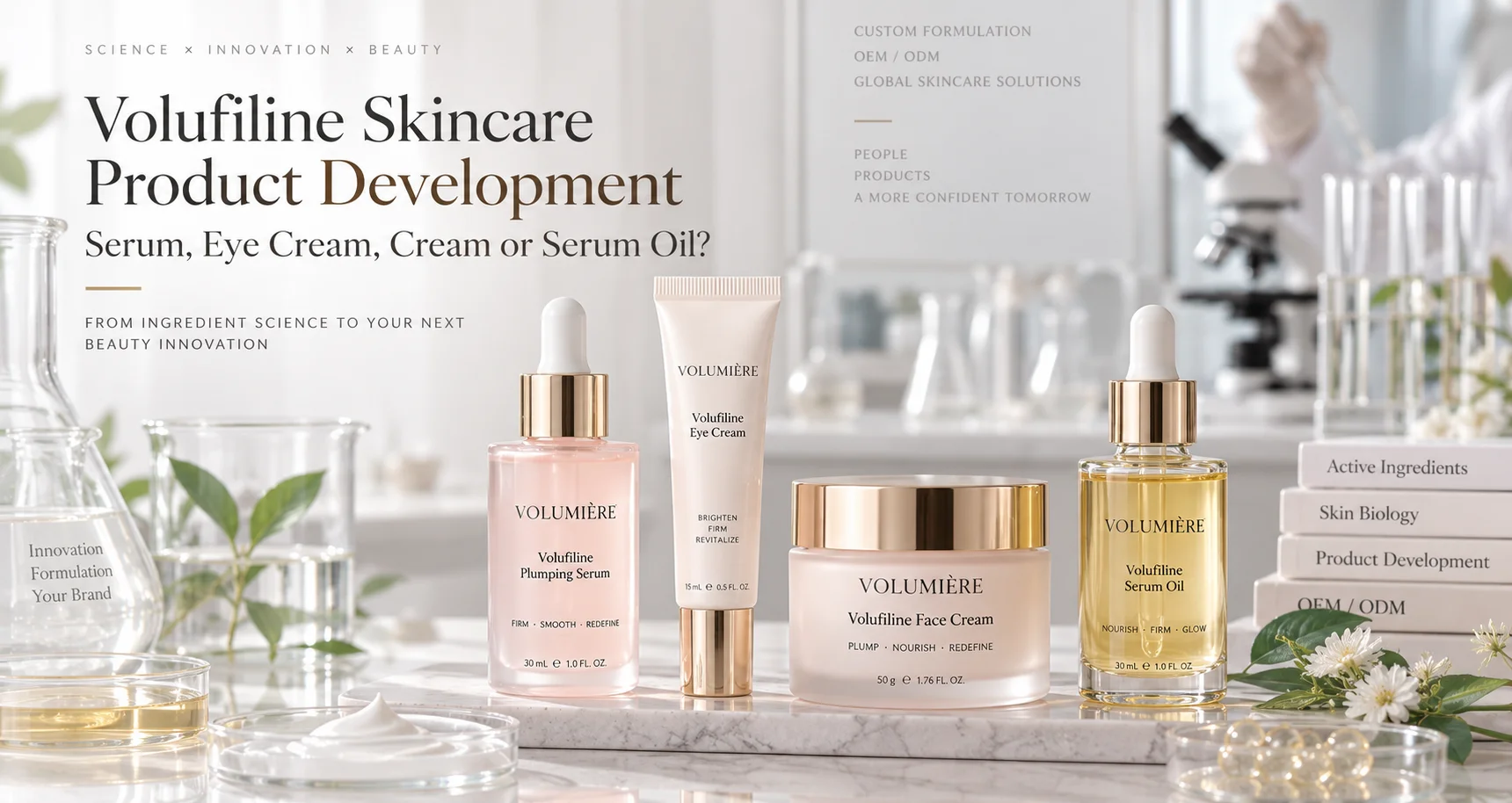
Xiran skincare’s current platform now includes more than one serum, including several Volufiline formats: a 3% Volufiline Spherical Peptide Firming Serum, 5% Volufiline Serum Oil, 5% anti-wrinkle face cream and 5% eye cream and an anti-aging toner concept. That’s not to say I think every brand should launch five products. It just gives us a useful way of looking at how the same hero ingredient can lead to very different commercial products.
“A Volufiline product” is not a useful product-development brief yet. One of the trends I’m noticing with trend-driven skincare is that brands will sometimes pick the ingredient first and then try to figure out who the product is really for. In practice, the headline ingredient is generally as much defined by the target consumer, application area, sales channel, expected texture and target retail price as the finished product.
A founder who started with TikTok and is trying to build one recognizable hero SKU has a very different brief to a mature skin brand selling through spas or professional channels. The first may want something light, easy to show, and simple enough to explain in a short video. The second may care more about richness, massage slip, after-feel and how the treatment slots into an evening routine.
This is also why I would avoid “plumping” as the entire product strategy. What that means to its customer is something the brand still has to decide. Is it for smoother-looking under-eyes, fuller-looking facial contours, fine-line care, firmness, or a more comprehensive mature-skin regimen? Once that part of the brief is sorted, it is much easier to decide on the format.
To make these development options more concrete, I’m drawing on our XIRAN Volufiline Product Development Presentation (PDF). It brings together our product concepts, ingredient and texture profiles, and selected testing summaries, providing the source material for the serum, eye cream and face cream examples discussed below.
For a new ingredient-led skincare brand, a serum is often the most simple place to start because consumers already understand where it fits in a routine. It also provides the marketing team with a clear hero ingredient, while still allowing room for peptides, humectants, barrier-support ingredients or retinoid-related actives to build a more complete story for the formula.
Xiran skincare’s existing 3% Volufiline Spherical Peptide Firming Serum is formulated with Volufiline, HPR, retinyl palmitate, a peptide system, hyaluronic-acid ingredients, ferments and other conditioning ingredients.
The sensory direction is now more of a velvety than a traditional thin watery serum. The useful lesson for me is not so much the length of the ingredient list, but how the product is structured.

Volufiline + peptides can be used to tell a plumping-and-firming story, or Volufiline combined with a more powerful hydration system can be used to create smoother, fuller-looking skin. This is an anti-aging formula with a broader scope, where Volufiline is just one piece of the positioning, for a mature-skin brand. You can call all these products “Volufiline serum,” but they are quite different in terms of sales.
“I also see brands underestimating texture in serum development. A sample may spread beautifully for the first ten seconds, and yet leave an oily or tacky film several minutes later. On the formulation sheet that may not seem like a big issue; for a customer who wants to put on moisturizer, sunscreen and foundation after, it can be the reason the product is not bought again.
That sort of sample can be more illuminating than simply whether the formula feels luxurious on first application, with useful information often coming from absorption after a few minutes, layering behavior and residual tack. No amount of hero-active percentage can make up for a serum that the customer does not enjoy using daily.
Eye care gives Volufiline a more defined consumer problem than any other generic facial serum. People shopping the category already cite dry under-eyes, visible fine lines, loss of firmness, tired appearance and hollow-looking areas so the brand has a more defined starting point for both formulation and communication.”
We are currently working on a concept of Volufiline eye cream 5% Volufiline with caffeine, HPR, retinyl palmitate, peptides, Sodium DNA, ceramide, hyaluronic acid and fermentation derived ingredients. I wouldn’t make that a product page where every ingredient is a hero. A customer is better able to understand a product when there is a clear hierarchy: plumper and smoother looking under-eyes is the main story, visible fine-line care is the second, with hydration and barrier support below.
There is also a question of the range here. If a brand already has three facial serums in the range, then a fourth product which just adds Volufiline because it’s trending may not add much to the range. The eye product can give the ingredient a new role, not just another dropper bottle competing for the same space in the customer’s routine.
The development criteria are also different. A rich eye cream can still feel elegant, but richness should not mean too much drag, migration or a sticky film around the lashes. When you’re sampling, that distinction tends to be a lot more useful than a vague request like “make it more premium.
It makes more commercial sense for a face cream to have Volufiline sit inside a familiar daily or nighttime anti-aging routine than it does as a highly targeted treatment. This can be especially true for mature audiences or those with dry skin that may appreciate comfort, moisturization and barrier support as much as the hero ingredient.
The current XIRAN cream concept combines 5% Volufiline with HPR, retinyl palmitate, peptides, Ceramide NP and antioxidant supporting ingredients. This gives more room for placement on plumper looking skin, firmness, visible lines, moisturization and barrier care without the customer needing to add another serum step.

For this cream, page 34 of our product development presentation summarizes reported third-party efficacy testing involving 33 participants over 28 days of continuous use. The figures below relate to the finished cream formulation presented in that document.

According to the reported test results, this cream demonstrated improvements in skin hydration, elasticity, and the appearance of wrinkles. Skin hydration increased by 47.6%, elasticity (R2) improved by 27.7%, and radiance increased by 31.0%, while skin roughness decreased by 22.7%. Nasolabial fold and crow’s feet wrinkle volumes were reduced by 9.2% and 23.4%, respectively. The firmness-related F4 parameter decreased by 39.2%, alongside a reported 2.2%.improvement in the mandibular angle measurement. Together, these results suggest that the cream helps support a smoother, more hydrated, and firmer-looking complexion with improved elasticity and less visible wrinkles.
I include these results as a reference for this specific cream, not as a promise that every Volufiline product will perform the same way. For a custom project, the final formula and proposed claims need to be considered alongside the underlying test documentation. These figures should not be interpreted as evidence of Volufiline’s isolated effect or automatically transferred to a different formulation; ingredient research, supplier data and finished-product testing answer different questions.
Serum oil is the format I am most hesitant to recommend for every brand. It can create a unique, luxury-feeling product but it does limit the consumer profile more quickly than a lightweight serum.
XIRAN’s current 5% Volufiline Serum Oil is a combination of Volufiline with squalane, jojoba, meadowfoam, argan and other oil-phase ingredients, with a silky oil texture as the desired sensory direction. This obviously leads to dry or mature skin, nite time routines, facial massage and more nourishing anti-aging positioning.
The same principle is less apparent to a customer who lives in a humid climate and would like an almost weightless product under SPF. So I like to pick the format from the consumer backward, rather than starting with whatever product type is getting the most buzz on social media at the moment.
During sample approval I would watch for even spreading of the oil, residual coating left after several minutes and if the pump or dropper provides a predictable dose. “Silky” and “greasy” can be differentiated by surprisingly small formulation differences, but the customer will immediately notice the difference.
A higher percentage doesn’t always mean a better finished product. The right level needs to make sense in terms of the product format, formula base, supporting active system, sensory profile, intended application area and target price.
This is demonstrated in the current XIRAN : the facial serum is built around 3%, while the serum oil, cream and eye-care concepts use 5%. Croda describes Volufiline as a cosmetic ingredient for professional formulated skincare, not something to be treated as a finished product in itself.
This will become more and more important as consumers start comparing percentages on packaging. “The biggest number might be tempting for a brand because it looks stronger in an Amazon image or a TikTok video, but the formulation team still has to think about spreadability, after-feel, stability, compatibility and cost.”
The better question for a product manager is “How high can we fly?” It is a matter of whether the level chosen supports the finished product the brand is really trying to sell.
Supporting ingredients should support one clear product concept – not become a catalog of whatever is trending that quarter. XIRAN Skincare Manufacturer has provided us with some beneficial directions, such as peptides, retinoid-related ingredients, ceramides, and moisturizing systems.

This is probably the simplest combo to understand for a firming-focused concept. The current peptide matrix is: Acetyl Hexapeptide-8, Arginine / Lysine Peptide, Oligopeptide-1, Dipeptide Diaminobutyryl Benzylamide Diacetate and soluble collagen peptide.
The story for the consumer doesn’t have to enumerate every peptide.
Volufiline is a much clearer path to a plumper-looking appearance, backed up by peptides in a firming and wrinkle care formula.
A handful of ideas in the range pair Volufiline with HPR and retinyl palmitate. This moves the positioning past simple plumping to broader questions of texture and the visible effects of aging.
It also poses further development questions around formula stability, packaging, consumer instructions and target-user tolerance. More actions do not necessarily make a better brief if the product becomes hard to use or hard to communicate.
Ceramides are particularly relevant in cream and eye-care concepts, where barrier support is already part of the customer’s expectation. Hyaluronic acid, glycerin and other humectants have a simpler hydration story to tell for smoother, fuller-looking skin.
This less complex route is sometimes commercially stronger than trying to combine all the currently popular actives in one launch.
For younger brands, one or two well-positioned Volufiline products will usually provide more useful market feedback than launching five SKUs simultaneously. XIRAN’s current concept can support a wider routine from toner through serum, serum oil, eye cream and face cream, which means brands have room to expand without committing to a full-range first order.
| Brand Type | Starting Product | Why |
|---|---|---|
| New DTC brand | Volufiline Serum | Clear hero-product story |
| TikTok / Amazon brand | Serum or Eye Treatment | Easy ingredient-led content |
| Eye-care brand | Eye Cream | Clear application and concern |
| Mature-skin brand | Serum Oil or Cream | Richer sensory positioning |
| Premium anti-aging brand | Serum + Eye Cream | Simple two-product routine |
| Established skincare brand | Multi-SKU range | Greater cross-selling potential |
It’s easy to overlook the operational aspect. Five SKUs are not just five products on a website, but multiple formulations, packaging combinations, artworks, compatibility checks, production schedules and inventory positions. A full range can look impressive in a presentation but it puts unnecessary cashflow pressure on a brand that hasn't yet learned what Volufiline proposition its customers actually want.
The level of customization is generally more of a factor in development time, cost and MOQ than the product name itself. For a founder who needs to quickly validate demand, a stock formula is often the practical choice, as much of the development work moves to packaging, branding and market positioning.
Semi-custom development is a compromise between speed and differentiation. Brand can begin on an existing platform but tweak chosen supporting actives, texture, sensory profile or packaging direction. Fully custom development is more suitable when the product needs a truly different base, a unique active system or a proprietary sensory experience but that usually means more sampling, testing and commercial commitment.
The useful question is not which sounds more premium. It’s about how much differentiation the business actually needs at this point. A first-time market test startup and an established retailer rolling out a multi-country launch have very different risk profiles.
Generally, the Minimum Order Quantity (MOQ) is around 1,000 units if using existing (stock) packaging. Final costs vary based on numerous factors, including the formulation system, the concentration of Volufiline (Anemarrhena asphodeloides extract), auxiliary active ingredients, formulation complexity, packaging type, decorative finishes, outer cartons, testing requirements, production scale, and the target market.
The cosmetic MOQ and packaging MOQ are not necessarily the same. A factory can make some amount of bulk formula, but a supplier for a custom colored airless bottle requires a much larger order. This is why we prefer to speak of formula, primary and secondary packaging rather than quoting an isolated "Volufiline serum MOQ".
In the case of a first launch, it’s often worth looking into stock packaging, even if the long-term plan is a fully custom component. Investing heavily in a proprietary bottle before the brand knows if the product will generate repeat purchase isn't always the best use of the development budget.
A Volufiline sample should not be approved simply because its ingredient list matches the brief. The real approval questions are often much more practical: Is the serum still sticky after several minutes? Does the eye cream migrate? Does the serum oil feel elegant rather than greasy? Does the face cream pill when used with products the consumer is likely to layer over it?
I also prefer testing samples within a realistic routine. A facial serum may perform beautifully on freshly cleansed bare skin but behave very differently once moisturizer, sunscreen and foundation are applied. These observations give the formulation team something useful to adjust before the brand commits to commercial production.
This is the type of development detail that rarely appears in an ingredient trend report, but it becomes very important once the product has to earn repeat purchases.
There should not be one identical test checklist for every Volufiline project. The testing plan should reflect the formula structure, packaging format, intended claims and destination market.
Depending on the project, that discussion may cover formula stability, microbiological quality, formula-packaging compatibility, viscosity and appearance changes, odor or color changes, pump or dropper performance, filling behavior, finished-product inspection and claim-support testing.
Packaging needs to enter this discussion early. A pump that dispenses a thin aqueous serum perfectly can behave very differently with a velvety silicone-rich serum or viscous eye cream. The intended packaging should therefore be tested with the actual formula before bulk production rather than leaving compatibility as a purchasing issue at the end.
For US and EU launches, I would position Volufiline primarily around cosmetic appearance benefits rather than language suggesting that a topical product physically replaces injectable procedures or changes underlying body structures.
The internal XIRAN development presentation uses strong concept language such as “non-injectable autologous fat grafting.” That wording communicates the internal development concept quickly, but it is not language I would automatically transfer to a US-facing product page.
The FDA explains that whether a product is regulated as a cosmetic or a drug depends partly on its intended use, and claims that a product affects the structure or function of the body can move it beyond ordinary cosmetic positioning. FDA guidance on cosmetics versus drugs FDA also states that cosmetic labeling claims must be truthful and not misleading. FDA Cosmetics Labeling Claims guidance
For a cosmetic Volufiline product, language such as “helps skin look plumper,” “supports firmer-looking skin,” “smooths the appearance of fine lines,” or “helps skin appear fuller and more hydrated” provides a much more defensible starting point. FDA’s guidance on anti-aging products likewise distinguishes cosmetic appearance claims from claims intended to alter skin structure or function. FDA guidance on wrinkle and anti-aging products
European brands need the same evidence discipline. Regulation (EC) No 1223/2009 on cosmetic products provides the core EU cosmetics framework, while Commission Regulation (EU) No 655/2013 establishes common criteria for the justification of cosmetic claims. The latter specifically emphasizes that information used in cosmetic claims should be useful, understandable and reliable.
The marketing discussion therefore belongs alongside formulation and testing, not after the product has already been manufactured.
A useful manufacturer brief needs to tell us much more than, “Please quote a Volufiline serum.” At minimum, I want to understand the intended product format, target consumer, primary concern, preferred supporting-active direction, texture, packaging concept, destination market, target retail price and estimated first order.
For example:
“A lightweight Volufiline + peptide serum for US ecommerce customers aged 30–45, designed to layer comfortably under sunscreen, with a target retail price below $40.”
That gives a formulation team something concrete to work with. It is far more actionable than simply asking for the strongest Volufiline formula available.
A good brief also forces the brand to make commercial decisions early. When price, channel and audience remain undefined, it is easy to spend weeks refining a technically interesting formula that does not fit the final business model.
There is no single answer, but the first SKU should have the clearest reason to exist within the brand’s assortment. For a young ecommerce company, I would still put a Volufiline serum near the top of the list because the format is familiar, easy to demonstrate and naturally suited to ingredient-led content.
If the brand already sells several facial serums, the eye cream becomes more interesting because it gives Volufiline a different role. For a mature-skin or spa-oriented line, serum oil or face cream may create a more coherent experience. An established anti-aging brand may eventually benefit from a small coordinated system, but that decision is easier once the company understands how its customers actually respond to the ingredient.
The longest ingredient list and the highest percentage are rarely enough to determine the best launch. The stronger first product is usually the one consumers can understand quickly, enjoy using and find a clear place for in their existing routine.
Xiran’s existing Volufiline product line offers the brand multiple entry points, without restricting every item to the same serum format. Current concepts cover a 3% facial serum, 5% serum oil, 5% face cream and 5% eye cream, each with a different supporting-active and sensory direction.

Instead of beginning with, “How much Volufiline can we put in the formula?”, the development conversation can start with the product itself. Does the brand need a lightweight hero serum, a targeted eye treatment, a richer mature-skin cream or a serum oil built around a more nourishing ritual?
Once that decision is clear, the technical questions become easier to solve. Volufiline level, supporting actives, texture, packaging, sampling and testing can then be built around one coherent commercial concept rather than selected independently. Brands that want to take that process into production can also review Xiran skincare’s broader private label and OEM/ODM skincare manufacturing capabilities.
A trending ingredient may be what gets a customer’s attention, but it cannot create the product strategy by itself. The better opportunity is to use Volufiline as the starting point for a product whose formula, texture, positioning, packaging and business model make sense together.
For many new brands, a Volufiline serum is the most straightforward starting point because consumers already understand how a serum fits into a skincare routine. It is also easy to build ingredient-led content around. However, if the brand already has several facial serums, an eye cream may create stronger differentiation. Mature-skin brands may find that a face cream or serum oil fits their positioning better. The best first SKU depends more on the target consumer and product story than on the ingredient alone.
Yes, Volufiline can be formulated into eye-care products, and under-eye use is currently one of the areas receiving significant consumer attention. From a product-development perspective, however, an eye cream needs more than a trending active. Texture, spreadability, migration, supporting ingredients and claims all need to be considered carefully. Brands may combine Volufiline with ingredients such as peptides, caffeine, hydration systems or barrier-support ingredients depending on the positioning.
For products using our existing packaging, the MOQ is typically 500–1,000 units. If you require custom packaging, the final MOQ will depend on the selected packaging and the packaging supplier’s minimum order quantity.
A serum generally makes more sense for brands that want a lightweight, easy-to-layer hero product, particularly for ecommerce or ingredient-led positioning. A serum oil is better suited to richer, more nourishing concepts aimed at dry or mature skin, nighttime routines or facial massage. Neither format is automatically better. The choice should reflect the target consumer, climate, desired skin feel and where the product is expected to sit within the routine.
Testing should be based on the finished formula, packaging and destination market. Depending on the project, this may include stability evaluation, microbiological testing, formula-packaging compatibility, viscosity and appearance checks, filling performance and finished-product inspection. If the brand plans to make specific performance claims, appropriate claim-support evidence may also be needed. The important point is that testing should not be treated as a generic checklist applied identically to every Volufiline formula.