Looking for private label cosmetics manufacturers in Europe? This guide compares 15 European suppliers across skincare, makeup, haircare, body care, and specialized cosmetics. For brands seeking low-volume ready-made products, Cosmetics Nord's Selfnamed program offers selected products without a minimum order. NOESIS publishes a starting MOQ of 500 units per product, while Tsilkov, Herrco, and Cosmewax have higher published manufacturing minimums. The right choice depends on your product category, customization requirements, target market, and production budget—not simply the lowest advertised MOQ.
Finding the right private label cosmetic manufacturer in Europe involves more than comparing product catalogs. A factory experienced in luxury makeup may not have the equipment required for a solid shampoo, while a skincare supplier offering ready-made formulations may not be the right partner for an original formula that requires extensive research and development.
For brand owners, purchasing managers, and product development teams, I recommend looking beyond the product range. Formula ownership, minimum order quantities, packaging requirements, testing, regulatory documentation, and repeat-order capacity can have a much greater impact on the success of a cosmetic launch.
Europe remains one of the world's most established beauty markets. According to Cosmetics Europe, cosmetics and personal care retail sales in Europe reached approximately €110 billion in 2025, with skincare representing the largest product category at €32.3 billion.
However, European cosmetic manufacturing is far from uniform. Germany, France, Italy, Spain, Portugal, the United Kingdom, and several other countries have manufacturers specializing in different products, technologies, and production volumes.
In this guide, I compare 15 European cosmetics manufacturers using their publicly described services, product specializations, manufacturing models, and available commercial information. I also explain which manufacturers may be better suited to startups, established beauty brands, and companies developing specialized cosmetic products.

The following comparison helps you identify manufacturers that may match your product concept before contacting their sales teams.
Rather than relying on general claims such as "flexible manufacturing" or "high quality," I have included publicly available minimum order quantities where the manufacturer provides them.
| Manufacturer | Country | Product Specialization | Manufacturing Model | Published MOQ |
|---|---|---|---|---|
| SKINOVATORS | Germany | Premium skincare, dermocosmetics | Private label, custom development | Not publicly disclosed |
| EXQUISITE Luxury | UK | Skincare, haircare, body care | Private label, bespoke formulation | 5 kg stated on private label enquiry page; finished-unit minimum to confirm |
| Groupe GM Cosmética Portugal | Portugal | Solid cosmetics, shampoos, soaps | White label, private label | Not publicly disclosed |
| Laboratoire BF International | France | Skincare, dermocosmetics, fragrances | Custom formulation, contract manufacturing | Not publicly disclosed |
| Art Cosmetics | Italy | Makeup, skincare, hybrid cosmetics | Contract manufacturing, custom development | Not publicly disclosed |
| Cobeco Pharma | Netherlands | Intimate care, wellness, cosmetics | Private label, ready and custom formulas | Not publicly disclosed |
| Dreiturm GmbH | Germany | Natural cosmetics, body care, haircare | Contract manufacturing, custom development | Not publicly disclosed |
| Cita Lieta | Latvia | Bath products, soaps, body care | Private label, white label | Not publicly disclosed |
| Cosmewax | Spain | Skincare, depilatory products | Private label, OEM/ODM | 10,000/SKU for skincare and hair removal; 25,000 for wax strips |
| Tsilkov Cosmetics | Bulgaria | Skincare, haircare, personal care | Private label, custom manufacturing | From 3,000/SKU |
| Cosmetics Nord | Latvia | Natural skincare, clean beauty | Private label, Selfnamed white label | No minimum for selected Selfnamed products; custom MOQ varies |
| TECHNATURE | France | Alginate masks, hydrogel masks, skincare | White label, custom manufacturing | Not publicly disclosed |
| Herrco Cosmetics | UK | Skincare, haircare, bath and body | Full-service contract manufacturing | From 5,000/SKU |
| NOESIS | Bulgaria | Skincare, haircare, personal care | White label, private label, contract manufacturing | From 500/product; component requirements may increase effective MOQ |
| MB Cosmetics Laboratory | Belgium | Skincare, haircare, selected makeup | White label, custom formulation | Small batches available; quantity not publicly specified |
The best cosmetics manufacturer in Europe depends largely on what your brand intends to sell.
A company developing pressed powder foundation should shortlist different suppliers from a business launching a natural shampoo or professional facial mask.
Based on their publicly described product capabilities, I would start with the following manufacturers.
| Your Product or Business Needs | Manufacturers to Evaluate | Why They May Be Suitable |
|---|---|---|
| Makeup and color cosmetics | Art Cosmetics | Dedicated makeup and skincare development |
| Premium facial skincare | SKINOVATORS, Laboratoire BF International | Formulation-led skincare and development services |
| Natural skincare and clean beauty | Cosmetics Nord, Dreiturm | Natural-focused formulations and manufacturing capabilities |
| Low-MOQ skincare launch | NOESIS, Cosmetics Nord / Selfnamed | Published small-order options for selected services |
| Haircare and body care | Herrco, Tsilkov, EXQUISITE Luxury | Experience across multiple personal care categories |
| Solid shampoo and bar cosmetics | Groupe GM Cosmética Portugal, Dreiturm | Specialized solid-format manufacturing |
| Bath bombs and spa products | Cita Lieta | Bath and body manufacturing specialization |
| Professional masks and hydrogel products | TECHNATURE | Dedicated mask and hydrogel technologies |
| Hair removal and depilatory products | Cosmewax | Specialized depilatory manufacturing |
| Intimate wellness products | Cobeco Pharma | Specialized intimate care and wellness formulations |
| Smaller custom development projects | NOESIS, MB Cosmetics Laboratory | Services positioned toward emerging and growing brands |
This table is a starting point for supplier qualification, not a ranking of product quality.
For example, a brand developing a premium facial serum may benefit from the laboratory capabilities of SKINOVATORS or Laboratoire BF. A startup testing a ready-made moisturizer under its own brand might find Cosmetics Nord's Selfnamed program more commercially practical.
Likewise, a company developing a makeup collection should investigate Art Cosmetics rather than assuming every skincare manufacturer can produce foundations, lipsticks, or pressed powders.
Before requesting a quotation, I recommend narrowing your shortlist to three to five manufacturers whose product capabilities match your brief.
I wanted this guide to provide more than another list of factories described as innovative, reliable, and capable of manufacturing almost anything.
When evaluating European private label cosmetic manufacturers, I focused on six practical considerations:
Manufacturing services. Does the company explicitly describe private label, white label, OEM, ODM, or third-party contract manufacturing?
Product specialization. Does the manufacturer have relevant experience in skincare, makeup, haircare, body care, solid cosmetics, or specialized treatment products?
Formulation development. Can the manufacturer work from an existing formula, adapt a base formula, or develop a new product?
Order requirements. Does the company publish MOQ information, and is that minimum associated with ready-made products or custom manufacturing?
Quality and regulatory support. Does the manufacturer describe appropriate manufacturing standards, product testing, documentation, and market-entry support?
Commercial suitability. Is the manufacturer positioned to support startups, small independent brands, established retailers, or larger commercial production?
The information in this article is based primarily on official company websites and public manufacturing service descriptions. I have not personally audited these factories, independently validated every displayed certificate, or obtained binding quotations from all 15 suppliers.
Best for: Premium skincare brands seeking coordinated formulation, manufacturing, and product development.
SKINOVATORS is a German private label cosmetic manufacturer offering a full-service approach to skincare and beauty product development.
The company describes its manufacturing model as a 360-degree service, covering early product concepts, research and development, formulation, packaging design, manufacturing, and warehousing.

Its strongest positioning is in professional skincare and premium cosmetic development rather than inexpensive, ready-made beauty products.
For brand owners building a sophisticated skincare collection, one advantage of this service model is the ability to coordinate several development stages through a single manufacturing partner.
This may be valuable when launching multiple products that require consistent positioning, coordinated packaging, and a clear development schedule.
Buyer consideration: SKINOVATORS does not prominently publish a standard finished-product MOQ in the materials reviewed. Before beginning a custom development project, ask about formulation fees, minimum batch quantities, sample revisions, regulatory documentation, packaging minimums, and formula ownership.
Best for: Boutique skincare, haircare, bath and body, and premium personal care brands.
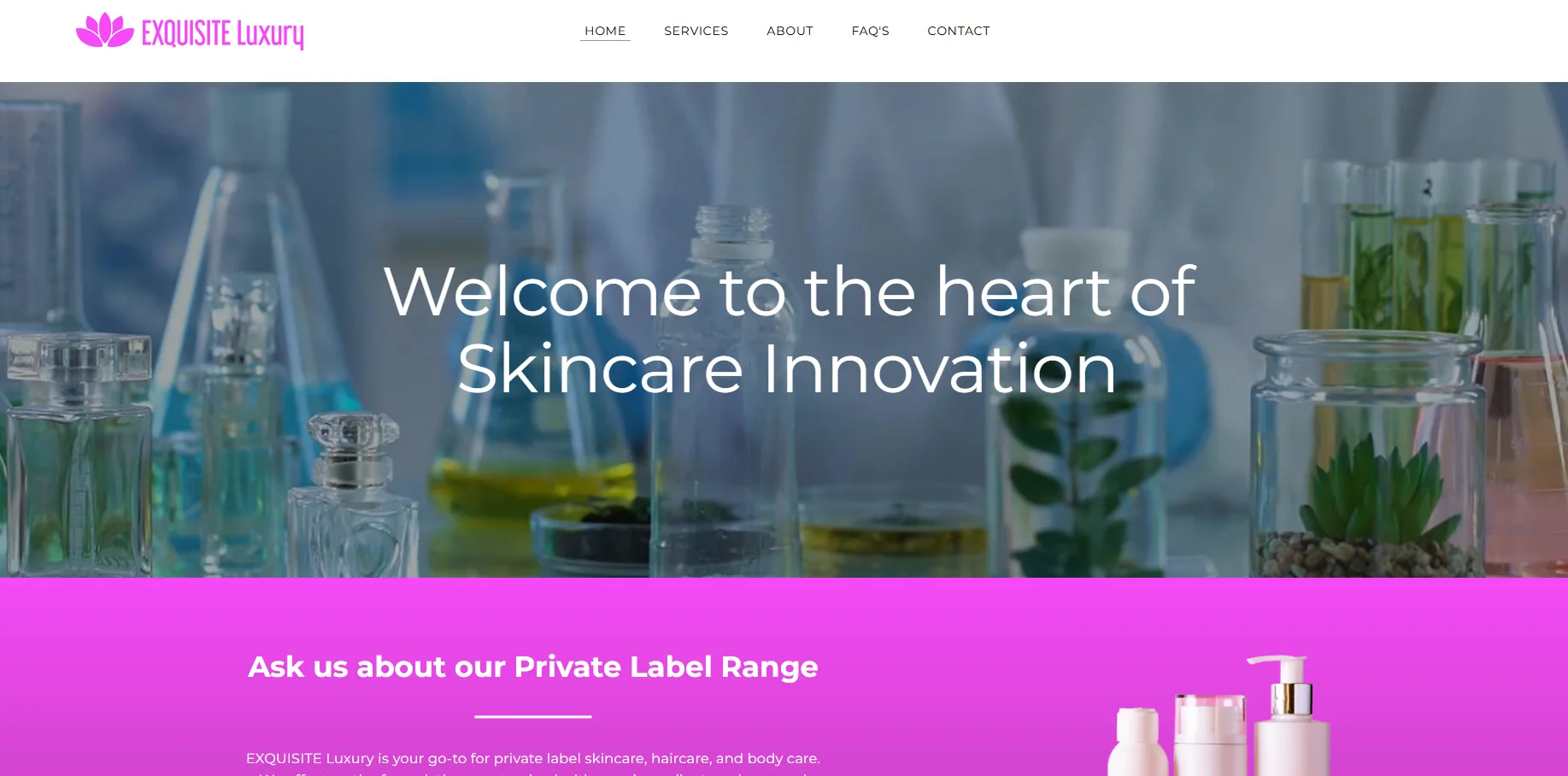
EXQUISITE Luxury is a UK manufacturer offering private label cosmetics and bespoke formulation services.
One useful feature of its business model is the ability to start with existing formulations while adjusting certain product characteristics. The company describes options for changing ingredients, fragrances, colors, and packaging, along with labeling and printing support.
This may be attractive to smaller beauty businesses seeking a differentiated product presentation without funding a completely new formulation.
For brands requiring more technical customization, EXQUISITE also describes in-house development services for bespoke products.
Its private label enquiry page states a minimum order of 5 kg. However, this should not be interpreted as a fixed number of finished units because the final quantity depends on product size, filling requirements, and packaging.
Buyer consideration: Confirm the finished-unit MOQ, packaging costs, and regulatory arrangements for your intended market. Cosmetics manufactured in the United Kingdom may require separate compliance arrangements for Great Britain and the European Union.
Best for: Solid cosmetics, sustainable personal care, hotel amenities, and shampoo bars.
Groupe GM Cosmética Portugal specializes in developing and manufacturing solid cosmetic products.
Its offering includes both white label and private label services. Under its white label model, buyers can select products from an existing catalog. Its private label process provides a more customized development route, including formulation, packaging selection, production, and quality control.
The company's production expertise makes it particularly relevant to brands developing solid shampoos, conditioners, soaps, and other compact personal care products.

Solid cosmetics can require different manufacturing equipment, formula stabilization approaches, and packaging considerations from conventional liquid products. For this reason, a specialist in solid formats may provide advantages over a general cosmetic manufacturer.
Groupe GM also has experience supporting hospitality-related products, making it worth investigating for hotel, spa, and travel-oriented collections.
Buyer consideration: Clarify whether your product will use an existing formula or require new development. Ask about packaging tooling, product dimensions, testing, and the manufacturing quantity required for your chosen solid format.
Best for: French-made skincare, dermocosmetics, fragrance-related cosmetics, and premium beauty collections.
Laboratoire BF International is a French formulation and contract manufacturing laboratory based in Paris.
The company describes more than 30 years of experience in cosmetic formulation, covering skincare, dermocosmetics, perfumes, and related scented products.

Its services extend from the initial product concept to finished cosmetic manufacturing, making it relevant to brands that want to coordinate technical development and production through a French partner.
Laboratoire BF states that its cosmetics production operates under an ISO 22716:2007-certified Good Manufacturing Practice system. It also develops products that may be eligible for COSMOS certification.
However, the ability to develop a product suitable for certification does not automatically mean every finished formula has been certified.
For brands emphasizing French manufacturing, professional skincare, or formulation-based differentiation, Laboratoire BF is worth considering.
Buyer consideration: Request clarification on custom development fees, minimum orders, testing responsibilities, certification scope, and whether regulatory documentation and packaging are included in the manufacturing proposal.
Best for: Makeup brands, prestige cosmetics, complexion products, and makeup-skincare hybrid collections.
Art Cosmetics is an Italian third-party cosmetics manufacturer specializing in makeup and skincare.
Unlike manufacturers whose primary focus is facial creams and cleansers, Art Cosmetics has significant experience in decorative cosmetics and related product development.
This makes it relevant to brands developing foundations, eye makeup, lip products, and formulas combining cosmetic coverage with skincare properties.

Makeup production introduces challenges that are less prominent in many conventional skincare products. Pigment dispersion, shade matching, color consistency, powder texture, and packaging compatibility can all affect the final product.
Art Cosmetics publicly describes dedicated research and development resources alongside its manufacturing operations, making it a potential partner for brands building more comprehensive cosmetic collections.
Buyer consideration: Before requesting samples, establish your intended number of shades, packaging components, target finish, and expected production volume. Each additional shade or product variation may create separate development, testing, or manufacturing requirements.
Best for: Intimate wellness, specialized personal care, and selected cosmetic products.
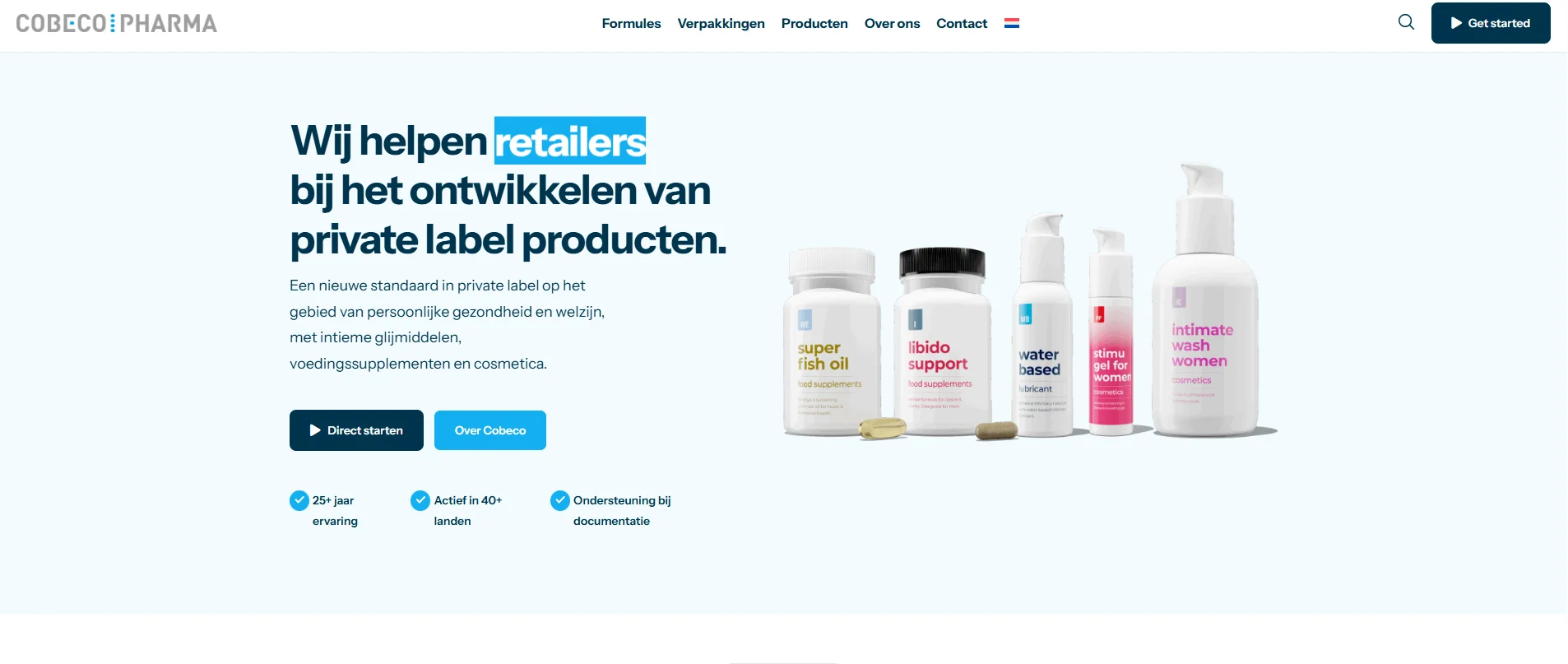
Cobeco Pharma is a Dutch private label manufacturer with a strong focus on intimate care and personal wellness.
Its product portfolio includes personal lubricants, hygiene products, cosmetics, and selected wellness categories.
Cobeco describes both ready-to-launch and tailor-made formulations, supported by packaging and regulatory documentation services.
This specialization matters because products intended for intimate use may require a different technical and regulatory approach from conventional facial skincare.
For example, product classification can change depending on a lubricant's intended purpose and claims. Buyers should not assume that every product in an intimate wellness collection is regulated in the same way as a standard cosmetic moisturizer.
Cobeco is particularly worth evaluating when intimate care is a core part of the business rather than a minor extension of a traditional skincare range.
Buyer consideration: Establish the intended legal product classification, required safety tests, applicable documentation, and target-market requirements before committing to formulation or packaging.
Best for: Established personal care brands, natural cosmetics, and multi-category retail collections.
Dreiturm GmbH is an established German manufacturer active in hygiene, health, and beauty products.
Its beauty division describes expertise in natural and conventional cosmetics, including skincare, body care, haircare, solid cleansing products, and selected sun-care formats.
One of Dreiturm's strengths is the range of product categories it can support.

For a purchasing team managing a collection of shampoos, body lotions, hand creams, and solid cleansing products, a manufacturer with broader production capabilities may simplify supplier coordination.
Dreiturm also describes experience with natural cosmetic standards and relevant certification frameworks.
However, brands should confirm which certification arrangements apply to the proposed formula rather than assuming that every product automatically qualifies.
Buyer consideration: Discuss forecast volumes, planned reorder frequency, packaging formats, and the manufacturer’s minimum production requirements early. A larger industrial manufacturer may be better aligned with repeat commercial production than small experimental batches.
Best for: Natural bath and body products, soaps, bath bombs, spa collections, and lifestyle beauty brands.
Cita Lieta is a Latvian cosmetics manufacturer associated with the Ceano Cosmetics brand.
The company has operated in cosmetics manufacturing since 2005 and offers private label and white label solutions for bath and body care.
Its publicly described capabilities include soaps, bath bombs, solid cosmetics, and other personal care products, with support for fragrance selection, packaging, and product development.

Cita Lieta offers a different type of manufacturing specialization from companies primarily focused on active facial serums or professional skincare.
For brands built around sensory experiences, gifting, fragrances, and spa-inspired product collections, that distinction can be important.
The availability of existing product formats may also help brands that want to launch a recognizable bath and body collection without developing every formulation from scratch.
Buyer consideration: Confirm which products can be customized, whether minimum quantities apply per fragrance or format, and what documentation is available for specific ingredient, natural-origin, or certification claims.
Best for: Established skincare brands, depilatory products, professional waxing collections, and larger production runs.
Cosmewax is a Spanish private label and contract cosmetics manufacturer specializing in skincare and hair removal products.
The company supports existing formulations and customized development, with services covering formulation, product testing, packaging, and regulatory considerations.
Its manufacturing specialization makes Cosmewax particularly relevant to brands developing connected product collections, such as depilatory products combined with pre-treatment skincare and aftercare products.
One advantage for procurement teams is that Cosmewax publicly provides its standard minimum order quantities.
According to its manufacturing FAQ, the published minimums are:
These minimums are considerably higher than those advertised by some small-batch or ready-made white label suppliers.
However, larger production quantities may be appropriate for brands with established sales channels and reliable demand forecasts.
Buyer consideration: Confirm MOQ conditions for your exact product format, the number of SKUs, packaging requirements, sample approval stages, and the expected manufacturing schedule.
Best for: Growing skincare, haircare, body care, and personal care brands.
Tsilkov Cosmetics is a family-owned Bulgarian private label cosmetics manufacturer offering formulation development, manufacturing, filling, and packaging.
Its product capabilities cover skincare, body care, haircare, and hygiene products, making it relevant to brands seeking several personal care categories from one supplier.
Tsilkov states that its manufacturing operations use ISO 22716 and ISO 9001-certified quality systems.

The company also publishes several commercial details that are often difficult to find on cosmetics manufacturers' websites.
Its standard production starting quantity is 3,000 units per SKU, with a typical manufacturing period of six to eight weeks after final approval.
This transparency helps brand owners make an initial assessment before requesting a detailed quotation.
However, it is important to distinguish manufacturing time from the entire product development timeline.
A brand developing a new cosmetic formula may need additional time for laboratory samples, packaging procurement, stability testing, and regulatory documentation.
Buyer consideration: Ask whether your chosen formula, packaging, and filling method qualify for the standard 3,000-unit minimum. Confirm when the quoted production timeline begins and which development stages are included.
Best for: Natural skincare, clean beauty brands, startups, and low-volume market testing.
Cosmetics Nord is a Latvian manufacturer offering natural and organic-oriented skincare development.
Its services include ready-made formulations, custom product development, manufacturing, packaging support, and regulatory assistance.
What makes Cosmetics Nord particularly interesting is the availability of different manufacturing and sales models.
Through its Selfnamed private label platform, brands can order selected ready-made cosmetic products without a minimum order requirement.

This model can be helpful for online beauty businesses, small independent brands, and companies validating consumer demand before committing to larger inventory quantities.
Selfnamed also supports branding and fulfillment options, creating an alternative to conventional bulk cosmetic manufacturing.
However, a ready-made white label product is not equivalent to an exclusive formulation.
A business seeking proprietary ingredients, unique performance characteristics, or substantial formula customization must discuss the separate requirements for custom manufacturing.
Buyer consideration: Decide whether your immediate objective is market testing or exclusive product development. For the former, Selfnamed may provide a practical entry point; for the latter, request a separate custom formulation proposal.
Best for: Professional skincare, alginate masks, hydrogel masks, patches, and spa treatment products.
TECHNATURE is a French cosmetic contract manufacturer specializing in professional skincare and advanced cosmetic treatment formats.
Its capabilities include alginate peel-off masks, powder formulations, serums, creams, gels, hydrogel masks, and hydrogel patches.
TECHNATURE's manufacturing infrastructure is particularly relevant to products requiring specialized textures, substrates, or mask technologies.

The company operates different production sites in France, with facilities dedicated to dry cosmetic formats, hot-pour products, and hydrogel-related manufacturing.
This makes TECHNATURE different from manufacturers whose main production equipment is designed around standard cream, lotion, and serum filling.
For professional spa brands, facial treatment collections, and cosmetic companies developing specialized masks, this technical focus may be valuable.
The company offers both ready-to-market white label solutions and custom formulation services.
Buyer consideration: Clarify whether the intended product is for professional treatment, consumer retail, or both. Ask about packaging requirements, product-use instructions, technical validation, and the minimum order applicable to your chosen format.
Best for: Established skincare, haircare, bath and body brands preparing for larger production runs.
Herrco Cosmetics is a UK full-service cosmetics manufacturer with formulation, testing and production capabilities.
The company specializes in skincare, haircare and bath and body products, offering both custom development and selected ready-made white label formulations.
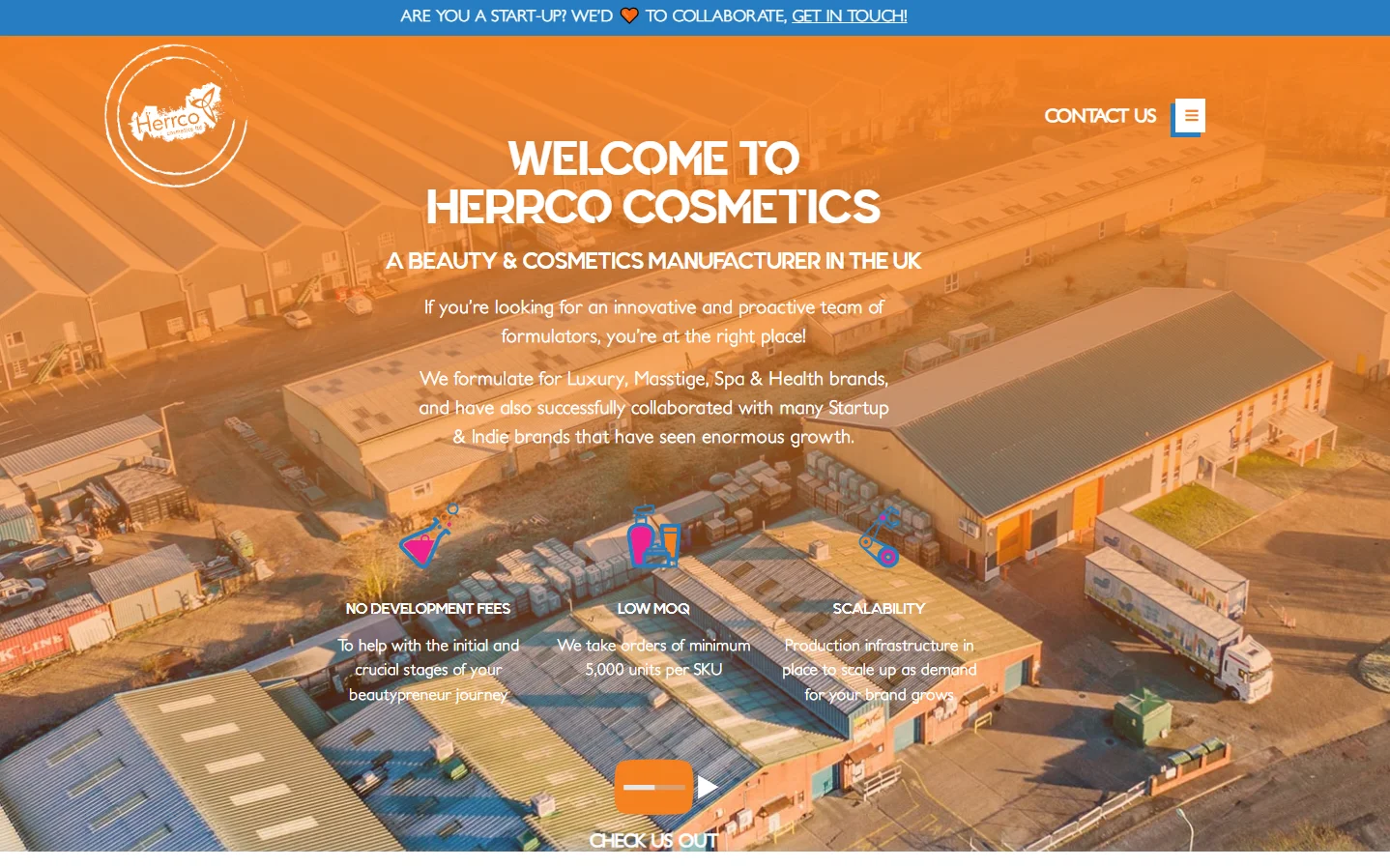
Herrco is relatively transparent about its manufacturing minimums, publishing an MOQ of 5,000 units per SKU.
For a brand with established retail distribution or predictable reorder requirements, this minimum may be commercially reasonable. For a newly launched product with untested demand, it may represent a substantial inventory commitment.
One other important distinction is that Herrco does not position itself as a general makeup manufacturer. Its FAQ states that it does not produce color cosmetics, although it can support selected tinted moisturizers and BB/CC creams.
Buyer consideration: Confirm whether your product fits the company's manufacturing specialization, whether the 5,000-unit MOQ applies to each variant, and how formulation, packaging, testing, and manufacturing charges are structured.
Best for: Startups, emerging beauty brands, small-batch production, and multi-category private label development.
NOESIS is a Bulgarian cosmetics manufacturer providing white label, private label, contract manufacturing, and custom formulation services.
Its manufacturing capabilities cover skincare, body care, haircare, and other personal care categories.
A major advantage for smaller brands is its published minimum order quantity.

According to the manufacturer's official MOQ guidance, standard minimum orders begin at 500 finished units per product for selected ready-made and custom formulation projects.
This provides a relatively accessible entry point for brands testing a new collection.
However, NOESIS also explains why a 500-unit manufacturing minimum does not automatically mean every project can be completed without additional material commitments.
Specialized ingredients, printed packaging, unusual filling components, or custom production requirements may involve supplier minimums above the intended finished-product volume.
In some cases, the manufacturer describes arrangements that allow customers to purchase and reserve excess materials for subsequent orders.
This approach can help brands understand the difference between production MOQ and the actual financial commitment required.
Buyer consideration: Request a quotation showing formulation development, raw material purchases, excess inventory, packaging components, manufacturing fees, and regulatory documentation separately. A 500-unit launch may be technically feasible without necessarily delivering the lowest unit cost.
Best for: Emerging skincare brands, boutique cosmetic collections, and custom product development.
MB Cosmetics Laboratory is a Belgium-based cosmetic formulation and manufacturing laboratory supporting brands developing skincare, body care, haircare, and selected makeup products.
The company provides ready-made white label formulations alongside custom product development.
Its services cover formulation, testing, manufacturing, filling, packaging, and cosmetic documentation.

For smaller businesses, one potential advantage is the opportunity to work with a development-focused laboratory that supports the process from early product ideas through commercial production.
MB Cosmetics also provides a comparatively detailed explanation of its development stages.
Its custom product development information describes formulation work, quality testing, regulatory preparation, and manufacturing as separate project phases.
This distinction is useful because founders sometimes assume that cosmetic manufacturing begins immediately after selecting an ingredient concept.
In reality, a fully custom product may require several rounds of formulation refinement before production can be scheduled.
Buyer consideration: Ask for an itemized project proposal that separates research and development, stability testing, safety documentation, packaging, and commercial production. The company describes small-batch capabilities but does not provide one universal publicly confirmed finished-unit MOQ.
When searching for private label cosmetics in Europe, you will encounter several manufacturing terms that are sometimes used interchangeably.
However, they do not always describe the same commercial arrangement.
| Manufacturing Model | What the Brand Receives | Customization Level | Suitable For |
|---|---|---|---|
| White Label | An existing cosmetic formulation sold under the buyer's brand | Usually branding and selected packaging | Fast launches and product testing |
| Private Label | An existing, adapted, or newly developed formula for a brand | Depends on the manufacturer | Startups and growing beauty brands |
| OEM / Contract Manufacturing | Production based on agreed formulas and specifications | Defined by the contract | Brands with technical requirements or existing formulas |
| ODM / Custom Development | Product design, formulation, development, and manufacturing services | Typically more extensive | Brands developing differentiated products |
White label manufacturing usually involves selecting an existing formula and applying your own branding.
This route can shorten development time because the supplier may already have a formula, established manufacturing process, and available packaging options.
For example, Cosmetics Nord's Selfnamed platform offers ready-made skincare products without traditional bulk-order minimums.
The trade-off is that the brand may have limited control over ingredients, texture, exclusivity, and other technical features.
Private label is a broader commercial term.
Some manufacturers use it to describe ready-made products with customized packaging. Others allow brands to modify fragrances, ingredients, textures, or other formulation characteristics.
When evaluating a private label cosmetics manufacturer in Europe, I recommend asking exactly which elements can be customized.
A supplier offering private label products does not necessarily provide exclusive formula ownership.
OEM or contract manufacturing generally refers to a manufacturer producing products according to agreed technical specifications.
Depending on the supplier, the buyer may provide an existing formula, request a modified formulation, or work with the factory to develop suitable manufacturing specifications.
The responsibilities of each party should be clearly defined in the manufacturing agreement.
ODM and custom development services typically involve more extensive product design and formulation work.
This route is suitable for brands seeking distinctive product performance, specialized ingredients, or a proprietary product concept.
However, custom development may require additional research fees, testing, packaging validation, and longer project schedules.
My recommendation: Do not choose a manufacturer based only on whether it uses the words OEM, ODM, or private label. Ask what the service includes, what can be changed, and who owns the resulting formulation.
Once you have identified several potential suppliers, the next step is to determine whether their services are technically, commercially, and operationally suitable for your brand.
I recommend evaluating the following six factors before requesting a final manufacturing quotation.

Start by defining exactly what you intend to manufacture.
A vitamin C serum, a pressed powder foundation, and a solid shampoo have very different technical requirements.
They may require different production equipment, quality checks, packaging components, and formulation expertise.
Before contacting a manufacturer, prepare a short product brief containing the intended category, target market, texture, key ingredients, packaging concept, and proposed launch quantity.
You should also clarify whether you want an existing formula, a modified formulation, or fully custom development.
A manufacturer describing itself as an OEM partner does not automatically offer every possible type of customization.
Minimum manufacturing quantity is only one part of the purchasing decision.
A supplier may accept a 3,000-unit production order, while the packaging supplier requires 5,000 printed bottles or pumps.
In this situation, the brand may need to purchase additional packaging inventory or select a different component.
The same issue can arise with specialized ingredients, fragrances, cartons, and printed labels.
For example, a brand launching three serum variations may need separate production batches if each formula contains a different concentration of active ingredients.
Before committing, ask for the minimum quantities covering the formula batch, packaging materials, printing, and each finished-product SKU.
Manufacturing cosmetics in Europe does not automatically guarantee that every requirement for legal market entry has been completed.
For cosmetics placed on the European Union market, the principal legal framework is Regulation (EC) No 1223/2009.
Brand owners and manufacturers should clearly establish who is responsible for the EU Responsible Person arrangement, safety assessment, Product Information File, product notification, labeling, and claim-support documentation.
The European Commission's Cosmetic Products Notification Portal provides the notification framework for cosmetic products placed on the EU market.
CPNP notification is not equivalent to product approval or an endorsement of manufacturing quality.
Brands selling in Great Britain must also consider separate UK notification and Responsible Person obligations.
A manufacturer may display ISO, GMP, COSMOS, or other certification logos on its website.
However, a logo alone does not explain whether the certificate is current, which facility it covers, or whether it applies to your specific product.
ISO 22716 is particularly relevant to cosmetic manufacturing because it provides Good Manufacturing Practice guidelines covering production, control, storage, and shipment.
For organic or natural cosmetics, brands should also distinguish between a manufacturer's certification arrangements and certification of the individual finished product.
I recommend requesting current certificate copies, the applicable scope, and supporting quality documentation before approving a significant production order.
The lowest quoted unit price does not always result in the lowest total project cost.
A meaningful supplier comparison should include formula development, sample preparation, product testing, manufacturing, filling, packaging, regulatory documentation, freight, and any additional service charges.
The production timeline also needs careful interpretation.
For example, Tsilkov publishes a typical production period of six to eight weeks after final approval. That does not necessarily include custom formulation development, repeated laboratory trials, packaging sourcing, or extended stability testing.
When comparing suppliers, request a milestone schedule covering the entire process from initial brief to finished-product delivery.
For a fully custom cosmetic formula, intellectual property ownership should be discussed before development begins.
Ask whether the formula will be exclusive to your brand, whether the manufacturing agreement restricts its use for other customers, and what happens if you later transfer production to another facility.
The agreement should also clarify packaging ownership, quality specifications, acceptance criteria, payment milestones, reordering conditions, and responsibility for defective goods.
These details can become more important than a small difference in unit pricing once your brand begins placing repeat orders.
For a European cosmetics project, regulatory preparation should begin before the product reaches commercial production.
For cosmetics placed on the European Union market, the central framework is Regulation (EC) No 1223/2009.
The main requirements include:
For products placed on the market in Great Britain, the UK operates a separate system. The UK government's cosmetic product notification guidance explains the relevant notification obligations.
Northern Ireland also requires separate consideration because its applicable cosmetic rules differ from those for Great Britain.
Brands should establish who will prepare and maintain the necessary documents rather than assuming the factory's manufacturing quotation includes every regulatory service.
A product manufactured in the EU is not automatically approved for sale in every market, and a product manufactured outside the EU is not automatically excluded from European distribution.
The finished product must comply with the rules of the market in which it is placed.ractive price once your brand begins placing repeat orders.
European cosmetic manufacturing offers several practical advantages, particularly for brands serving European customers.
Geographic proximity may simplify factory visits, communication, regional distribution, and inventory replenishment.
Manufacturing in countries such as France, Italy, or Germany may also support a brand's positioning when genuine European manufacturing origin is important to its customers.
However, European manufacturing is not automatically the best commercial solution for every product.
Some businesses require different production minimums, broader packaging customization, or formulation capabilities that may be more suitable at an overseas factory.
| Consideration | European Manufacturing | Overseas Manufacturing |
|---|---|---|
| Market proximity | Often advantageous for European distribution | International shipping and customs may be required |
| Manufacturing costs | Vary by country, product, and production scale | May be competitive, but total landed costs must be assessed |
| Product customization | Depends on supplier capabilities | Also depends on formula, equipment, and supplier |
| Minimum orders | Range from no-minimum white label programs to large manufacturing batches | Vary by factory, formula, and packaging |
| EU regulatory compliance | Required for products sold in the EU | The same EU product rules apply to imported cosmetics |
| Brand positioning | May support genuine European-origin claims | Origin claims must reflect actual manufacturing location |
| Replenishment | Potentially shorter regional supply chains | May require longer delivery and inventory planning |
When comparing suppliers, I recommend looking at the complete project rather than manufacturing location alone.
The more useful comparison includes product quality requirements, technical support, manufacturing capacity, packaging options, total cost, and regulatory responsibilities.
At Xiran Skincare, we work with international beauty brands developing private label skincare, facial care, and body care products.
Our manufacturing model combines laboratory formulation and production, allowing us to coordinate product development, sampling, packaging selection, and bulk manufacturing.
For selected standard private label programs, our MOQ starts at approximately 1,000 units per SKU. Sampling typically takes 7–10 days, while bulk production generally requires 25–45 days after formula, packaging, and order approvals.

Custom formulas, specialized packaging, testing requirements, and production quantities can affect the final schedule and minimum order.
Brands seeking more differentiated products can explore our custom cosmetics formulation services. We also provide private label skincare manufacturing and custom cosmetic packaging support.
Xiran Skincare is based in China, not Europe.
For brands planning to sell products in the European Union, the appropriate Responsible Person, safety documentation, labeling, and notification arrangements must still be established.
If you are comparing European and overseas manufacturers, we recommend evaluating the full manufacturing proposal, including the effective MOQ, packaging, production costs, development support, and total landed cost.
Europe offers a broad range of private label cosmetics manufacturers, from specialized skincare laboratories and makeup producers to natural body care manufacturers and large industrial suppliers.
However, the best partner depends on your actual product requirements.
For startups testing an existing skincare concept, a ready-made white label program may provide a relatively accessible route to market.
For brands launching proprietary serums, professional masks, or comprehensive makeup collections, formulation expertise, quality documentation, technical capabilities, and manufacturing scale become more important.
Rather than contacting every supplier in this guide, I recommend preparing a detailed product brief and shortlisting three to five manufacturers that fit your product category, target market, and expected order volume.
Compare their manufacturing capabilities, effective MOQ, development costs, formula ownership arrangements, quality systems, and regulatory responsibilities before making a final decision.
The best private label cosmetics manufacturer is not necessarily the largest or the cheapest. It is the partner that can consistently manufacture the right product for your brand at a commercially sustainable cost.
Minimum order quantities vary considerably depending on the supplier and manufacturing model. Cosmetics Nord's Selfnamed service allows selected ready-made skincare products to start from one unit, while Tsilkov publishes a standard MOQ of 3,000 units per SKU. Herrco lists 5,000 units and Cosmewax lists 10,000 units for skincare. Fully custom formulations and specialty packaging may require different minimums, so brands should request product-specific quotations before planning their launch quantities.
There is no reliable single price for European cosmetic manufacturing because cost depends on formulation, order size, packaging, testing and development requirements. For illustration, a hypothetical order of 3,000 units at an agreed manufacturing price of €4 per unit would represent €12,000 in product manufacturing costs before any separately charged development, testing, documentation, packaging or freight expenses. This is a budgeting example, not a verified market quotation. Request itemized proposals to compare total costs accurately.
A ready-made white label product may require relatively little formulation development, while a fully customized cosmetic can take several months to formulate, test and approve. Production itself is a separate stage. For example, Tsilkov publishes a typical manufacturing period of six to eight weeks after final approval. Packaging procurement, sample revisions, stability testing and regulatory documentation can extend the total timeline. Brands should request a milestone schedule covering development through final delivery.
Cosmetics sold in the EU must comply with Regulation (EC) No 1223/2009. Key requirements include an EU Responsible Person, a safety assessment and Cosmetic Product Safety Report, a Product Information File, appropriate manufacturing and quality documentation, compliant labeling and notification through the CPNP before market placement. Specific products may also require additional supporting information or testing. The manufacturer may help prepare these materials, but contractual responsibilities should be clearly established.
White label typically involves selecting an existing formula and applying your own branding, often with limited customization. Private label is a broader commercial term that can include ready-made or modified formulas sold under the customer's brand. OEM manufacturing generally refers to making products according to agreed specifications, while ODM may include product design and formulation development. Suppliers use these terms differently, so it is important to ask what can actually be customized and who owns the resulting formula.
Yes. Cosmetic products manufactured outside the EU can be sold in the European Union when they meet the applicable regulatory requirements. Brands must establish the appropriate EU Responsible Person arrangement and ensure that the finished products have the necessary safety documentation, Product Information File, labeling and CPNP notification. Importing also introduces customs, freight and other commercial considerations. Manufacturing in Europe is not itself a legal requirement for cosmetic market entry.