If you’ve ever come home from a day at the beach, looked in the mirror and thought, I wore SPF 50 all day—why am I still tan?you're not nuts,
Sunscreen can reduce tanning significantly, but it doesn’t guarantee that your skin won’t tan at all.
There’s an important difference, because people often think of sunscreen as an invisible wall between skin and sunlight. Nope. A sunscreen that is formulated well cuts down on the amount of ultraviolet radiation that reaches the skin. It doesn’t block UV exposure completely.
This is also why I never look at the SPF number alone from a formulation point of view. In the real world, it matters whether the protection is broad-spectrum, how evenly the product spreads, how much you put on, how well it survives sweat and water, and whether you actually reapply.
So a better question is not just, “Does sunscreen prevent tanning?”
"It is:
How much can sunscreen block UV-induced tanning, and what makes that protection effective — or not — in everyday use?
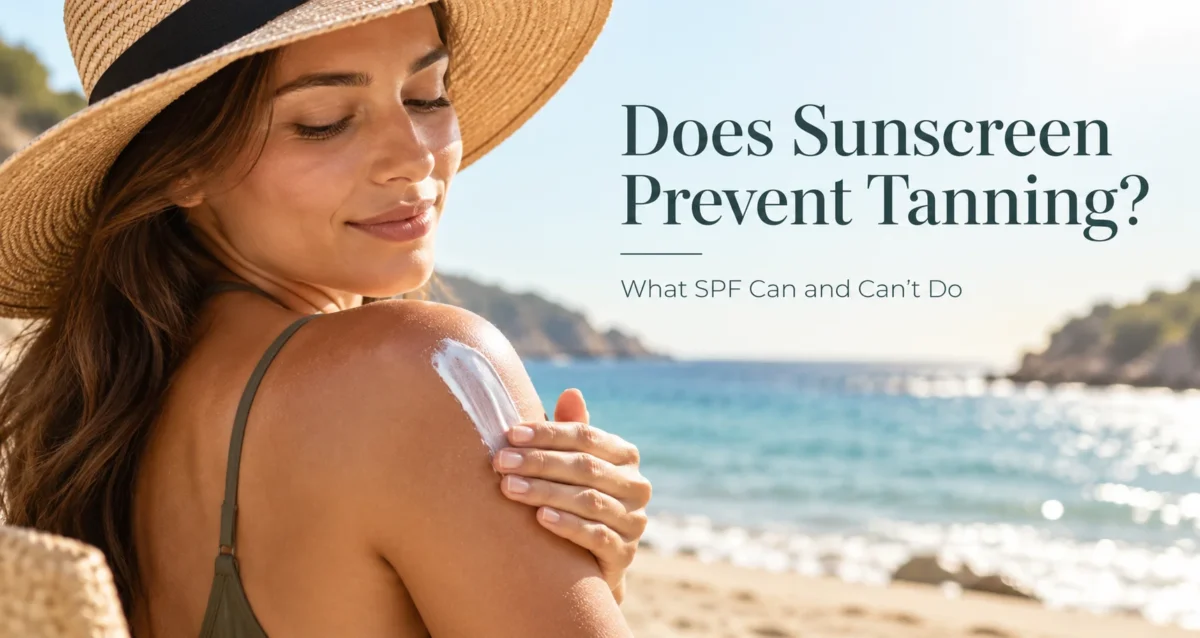
Sunscreen will reduce your tanning a lot, but not stop it completely. No sunscreen blocks 100% of ultraviolet radiation and even with proper application of SPF 30 or SPF 50, a small amount of UV can still reach the skin. To minimise tanning, use broad-spectrum SPF 30+; use enough; reapply every two hours outdoors; combine sunscreen with shade and protective clothing.
The American Academy of Dermatology recommends a broad-spectrum, water-resistant sunscreen of at least SPF 30 or higher, but emphasises that sunscreen alone cannot provide complete UV protection.
But before we get into SPF numbers, I think it's helpful to understand what a tan actually is.
UV radiation strikes the skin and the pigment-producing cells (melanocytes) react by producing more melanin. It is the extra pigment that makes the skin look darker.
This can be a healthy adaptation, because a tan can look even, glowing or cosmetic, and it’s easy to think of it as such.
But biologically, that's not what health authorities call it.
The CDC has stated very clearly that any change in skin colour after exposure to UV light, be it a tan or a burn, is a sign of injury, not health. And the American Cancer Society reports there is no such thing as a safe UV tan.
That doesn’t mean that every little stint outside is a medical emergency. That is to say, I would not call intentional UV exposure “safe tanning.”
The purpose of sunscreen is to minimise damage, not to make tanning safe.
This is probably the most common misconception I run into.
SPF 30 does not mean:
30% less tan
SPF 50 does not mean
“I don’t tan.
SPF stands for Sun Protection Factor and on US sunscreen labels it mainly describes protection against UVB – the radiation most strongly linked to sunburn.
According to the AAD, SPF 15 blocks around 93 percent of UVB rays, while SPF 30 blocks around 97 percent. Higher SPF filters a little more UVB . No sunscreen filters 100 % .
That tiny percentage still left is a reason tanning can still occur.
But there’s one more piece that’s just as important. UVA.
I usually keep this part simple when I explain sunscreen to someone who does not work in formulation or dermatology.
UVB is very much a burning ray .
UVA penetrates more deeply and is the major player in photoaging and pigmentation changes.
Both of those matter.
That's why I don't just read the "SPF 50" on the front of the bottle. I also want to see broad spectrum, which tells me the sunscreen is meant to protect against UVA and UVB.
The AAD refers to UVA as the "ageing" rays and UVB as the "burning" rays. It also points out a common misconception that many people don’t know: UVA can pass through regular window glass, while UVB is mostly blocked by it.
Which is handy if you do a lot of driving or sitting next to a sunny window.
You can’t burn behind glass, but that doesn’t mean UVA exposure is gone.
Here’s where the laboratory SPF number meets real life.
A sunscreen may perform beautifully in standardised testing, but still be a disappointment if it’s applied too thinly, unevenly, or just once during a long day outdoors.
I’m inclined to call this an exposure gap.
The sunscreen is working , but the user is getting more UV exposure than expected because of their usage.

The sunscreen should form a fairly even film over the skin.
I can't expect the same real-world protection as the SPF tested under standardised conditions, as labelled, if I apply a small amount over a large area.
The FDA provides a helpful body reference: The average adult needs about 1 ounce of sunscreen, or a shot glass worth, to cover exposed face and body skin.
AAD also notes most adults need about an ounce for exposed skin, and gives about a teaspoon for the face for a practical reference.
I find this more helpful than telling someone to "apply generously", because generous means different things to different people.
Another common scenario is applying sunscreen at 9 a.m. and thinking that same application provides full protection at 3 p.m. Because of extended outdoor exposure, the FDA recommends reapplying at least every two hours, and more often when swimming or sweating.
The AAD offers similar advice.
But that doesn’t mean you have to put on a two-hour timer and sit in a windowless office all day. It means that a beach, hiking trail, outdoor cafe, pool or sports pitch requires a different approach than an indoor workday.
There is also a lot of confusion about “water resistant”.
Not waterproof.
Water resistance in U.S. sunscreen labelling is typically 40 or 80 minutes, after which the sunscreen must be reapplied, as indicated on the label. The AAD’s current sunscreen labelling guidance makes this distinction clear.
I do not assume my original sunscreen film is intact if I've been swimming, sweating heavily or towelling myself.
There is also a behavioural problem that is less often addressed.
Some people apply SPF 50 and then stay in the sun way longer than they would without sunscreen.
I would never view sunscreen as a license to keep my UV exposure going indefinitely.
It reduces the amount of UV light that hits your skin. It is not the same as sitting in the direct summer sun for six hours inside.
That’s why sunscreen is most effective as part of a wider sun-protection strategy rather than as a stand-alone layer.
SPF 30 is a measure of how well a sunscreen protects you from the sun’s harmful UVA and UVB rays. It does not prevent tanning, it only slows it down.
“SPF 30 will reduce tanning considerably as it will reduce exposure to UV rays, but it cannot promise no tanning.”
SPF 30 filters about 97% of UVB radiation when used as tested, according to the AAD.
That is a great protection compared to unprotected exposure.
Not quite there yet.
More critically, the SPF number is just one part of the product. If you are trying to minimise tanning, I would look for:
Water-resistant + SPF 30 or higher + broad-spectrum protection
rather than just SPF.
Those are also the three characteristics the AAD recommends consumers look for when purchasing sunscreen.

Generally, SPF 50 offers a little more UVB protection than SPF 30, but the jump isn’t quite so drastic as going from “some protection” to “no tanning.”
Both still allow some UV to reach the skin.
Higher SPF numbers block a little more UVB than SPF 30, but the AAD cautions that no SPF blocks 100% and higher SPF doesn’t last longer.
That last point is important.
A higher number, like SPF 50, doesn't mean you can skip reapplication.
But if I had to choose between one person applying a generous amount of an appropriate broad-spectrum SPF 30 and reapplying it, and another applying a tiny amount of SPF 50 once in the morning, I would have a lot more faith in the first routine.
Practical application is important.
Wide Range Is More Important Than Most People Realise
If the goal is simply to eliminate tanning and uneven skin tone I would not purchase sunscreen based on simply the largest SPF number on the shelf.
I'd look for broad spectrum.
It’s particularly important because tanning isn’t just a UVB problem.
The AAD also notes that visible light can make hyperpigmentation worse, especially in darker skin tones. It recommends tinted broad-spectrum SPF 30+ sunscreen with iron oxides for those concerned about pigment, and also recommends shade and protective clothing.
But that doesn't mean everyone needs tinted sunscreen.
That is to say, “my skin looks darker” can sometimes be more complicated than just tanning.
Tan, Dark Spots And Hyperpigmentation Aren't Always The Same Thing
This is an important distinction because the words are often used interchangeably by people .
A fairly homogeneous darkening after a holiday can be UV-induced tanning.
Post-inflammatory hyperpigmentation is the dark spot that remains after an acne lesion has healed.
Other causes of patchy or recurrent facial pigmentation
If I was creating content or products about pigmentation, I wouldn’t refer to all forms of darkening as “tan”.
This is even more important for darker skin tones, where uneven pigmentation can show up more prominently or persist longer.
And this is also why, if someone says, “My sunscreen isn’t working because I’m getting darker,” they may need to look at more than just SPF.
Yes, some UV will pass through glass.
The important difference is the type of radiation.
The AAD says UVA can go through window glass, but UVB is blocked far more effectively.
So even if I’m working daily next to a large sunny window or driving for hours, I still think broad-spectrum protection.
Sunburn does not mean meaningful exposure.
This is also why UVA protection matters to people who are concerned about photoaging and uneven pigmentation, not just burning.
Every skin tone needs sun protection.
Of course, higher melanin levels do provide some protection against UV, but they do not make the skin immune to UV damage.
According to the CDC, everyone is susceptible to sunburn regardless of race, ethnicity or skin tone, and too much exposure to UV rays can damage skin cells.
Also, darker skin may develop more pigmentation changes after UV and visible-light exposure.
If avoiding uneven darkening is a priority, broad-spectrum SPF 30+, shade and clothing are still relevant. As I mentioned earlier, tinting sunscreen with iron oxides can be helpful for some people with hyperpigmentation specifically from visible light.
This is where I would choose my words carefully.
I would not tell anyone:
"Get your SPF on, tan safely."
Intentional UV tanning is not considered safe by major health organisations.
A tan is a sign of injury to the skin, according to the CDC. The American Cancer Society also points out that there is no safe amount of UV tanning, and a base tan offers little meaningful protection.
That doesn’t mean the sunscreen didn’t work, because you got some colour.
That is, the goal of sunscreen is to minimise UV damage, not to provide a controlled system for tanning.
If you are not really after UV exposure, but appearance, there is a much more sensible option.
I differentiate tanning the skin with UV from making the skin look tan.
That is not the same thing.
Sunless tanning products create temporary colour without UV light. The American Cancer Society says topical self-tanners with DHA are an alternative to UV tanning.
The important caveat is self-tan is not sunscreen.
The AAD specifically recommends using broad-spectrum SPF 30+ even when using self-tanning products.
My practical rule is:
Self tanner to colour. UV protection sunscreen.
I would not expect one product to automatically replace the other unless it was specifically formulated and labelled to provide both functions.

I wouldn't just look for the highest SPF number possible, then ignore everything else.
I’d go for a wide spectrum SPF 30+ that’s water resistant and feels good enough to apply properly.
Then I would look for quantity.
For a full exposed adult body, about 1 ounce is a good reference. The general recommendation is to apply sunscreen prior to substantial outdoor exposure, and current FDA guidance suggests applying sunscreen roughly 15 minutes before going outdoors.
If I'm out for hours, I reapply about every two hours, sooner if water, sweat or towel drying is involved.
And if avoiding tanning is very important, I do not stop with sunscreen.
Shade, a wide-brimmed hat, sunglasses, and sun-protective clothing all cut down on the amount of UV the sunscreen will have to work with in the first place.
That layered approach is exactly why the AAD emphasises sunscreen as one component of sun protection—not full protection by itself.
| What You're Seeing | What May Be Happening | What I'd Check |
|---|---|---|
| Overall tan after a vacation | High cumulative UV exposure | Time outdoors, shade and reapplication |
| Face darker than neck/body | Uneven sunscreen coverage | Hairline, ears, nose and application amount |
| Tan despite SPF 50 | Sunscreen doesn't block all UV | Broad spectrum, quantity and time outside |
| Darker after swimming | Sunscreen film may have changed | Water resistance and reapplication |
| One side darker after driving | Repeated UVA through windows | Daily broad-spectrum protection |
| Persistent uneven patches | May not be simple tanning | Pigmentation pattern and professional advice if needed |
The reason I like this table is that “my sunscreen didn't work” is often too broad a diagnosis.
Sometimes the sunscreen is perfectly good. The exposure pattern is the real issue.
Does sunscreen prevent tanning ?
Not so far.
A good sunscreen can greatly reduce the amount of ultraviolet radiation reaching the skin and thus reduce tanning, burning, photoaging and other damage caused by UV But zero exposure is zero SPF.
That's why I don't judge a sunscreen by the number on the front of the bottle.
I consider broad spectrum protection, the way the formula wears, if it’s water resistant, how comfortable it feels in the right amount and if somebody is going to realistically reapply it.
Those details matter because sunscreen is only as good as its application.
And I’d like to keep one distinction clear: if you want to look tan, a sunless tanning product is a much better way than deliberately increasing UV exposure. If you’re serious about protecting your skin, sunscreen should be a part of your strategy that includes shade, clothing and sensible exposure, not a replacement for them.
SPF is a very handy tool.
It's not a cloak of invisibility for sunlight.
SPF 30 can significantly reduce tanning, but it cannot guarantee that you will not tan. The AAD states that SPF 30 filters approximately 97% of UVB radiation, while no sunscreen filters 100%.
No. SPF 50 can provide very high UVB protection, but some UV exposure can still occur. Higher SPF also does not last longer than lower SPF, so reapplication is still necessary during extended outdoor exposure.
About every two hours during prolonged outdoor exposure. Reapply sooner after swimming, heavy sweating or towel drying.
Current FDA guidance recommends applying sunscreen about 15 minutes before sun exposure.
A good starting point is broad-spectrum, water-resistant SPF 30 or higher. Apply enough, reapply during prolonged outdoor exposure and combine sunscreen with shade and protective clothing.