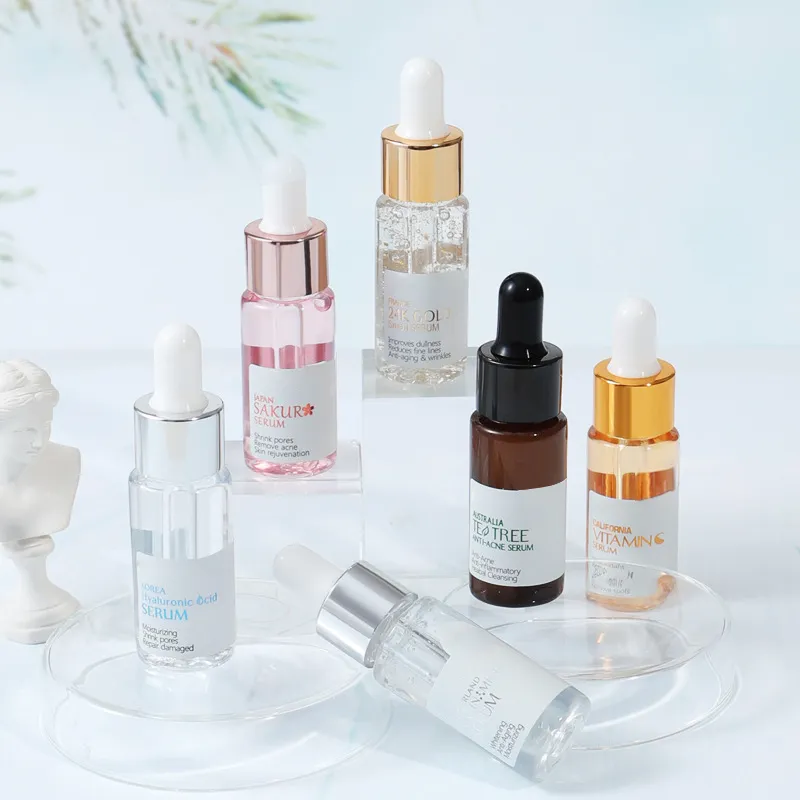
To create a facial serum for your own skincare brand, start by defining your product concept, choose the right ingredients and formula, select packaging, test samples, and work with a manufacturer to produce your finished serum. You can start with an existing private label formula or develop a custom serum based on your brand's requirements.
You don't need your own cosmetics laboratory or years of formulation experience to launch a facial serum. What you do need is a clear idea of who your product is for, what makes it different, and how much you're prepared to invest.
At Xiran Skincare, we help beauty founders and established brands develop facial serums, from simple hyaluronic acid formulas to specialized products featuring peptides, vitamin C, retinol, and other cosmetic actives.
Whether you're creating your first product or expanding an existing skincare collection, these six steps will help you turn your idea into a product ready for manufacturing.

Start by identifying your target customer, the main benefit your serum will provide, and how you want to position your brand. These three decisions will guide your formula, ingredients, packaging, and selling price.
For example, a skincare brand targeting younger consumers who prefer minimalist routines may want a lightweight, affordable hydration serum. A premium brand may focus on a more specialized formula, luxurious texture, and distinctive packaging.
Before contacting a manufacturer, answer three questions: Who will buy this serum? What skincare benefit are they looking for? Why would they choose your product instead of another serum?
If you're launching your first skincare product, we recommend focusing on one main benefit rather than trying to create a serum that addresses every skin concern.
Here are some common facial serum concepts to consider:
| Serum Type | Target Customer | Product Positioning |
|---|---|---|
| Hydrating Serum | Dry or dehydrated skin | Everyday hydration and comfortable skin feel |
| Brightening Serum | Dull or uneven-looking skin | Radiance and more even-looking tone |
| Peptide Serum | Customers concerned about visible aging | Smoother and firmer-looking skin |
| Barrier-Support Serum | Customers seeking gentle daily care | Moisturizing and skin-conditioning benefits |
| Clarifying Serum | Oily or combination skin | Lightweight care and improved skin appearance |
| Retinol Serum | Customers seeking a nighttime anti-aging routine | Improving the appearance of fine lines, where supported |
For a first product, a hydrating or niacinamide serum may offer a straightforward concept that customers can understand.
However, the best choice isn't necessarily the most popular ingredient. It's the product that fits your audience, price positioning, and brand identity.
Our recommendation: Start with one hero serum. Once you've tested customer demand and collected feedback, you can introduce complementary products.
At Xiran Skincare, we recommend pre-tested base ingredients for your brand’s serums based on the specific skincare benefits you wish to deliver. We also offer the option for fully customized formulations.
Some of our most popular choices include:
| Serum Concept | Potential Key Ingredients | Product Development Focus |
|---|---|---|
| Hydrating | Hyaluronic Acid, Glycerin, Panthenol | Lightweight hydration and reduced tackiness |
| Brightening | Vitamin C, Niacinamide | Radiance, ingredient stability, suitable pH |
| Peptide | Cosmetic Peptides, Hyaluronic Acid | Ingredient compatibility and sensory feel |
| Barrier Support | Ceramides, Ectoin, Beta-Glucan | Moisturization and comfortable texture |
| Soothing | Centella Asiatica, Panthenol, Allantoin | Gentle sensory characteristics |
| Retinol | Retinol or Retinal, suitable supporting ingredients | Stability, packaging protection, regulatory limits |
For example, if you're building a hydration-focused brand, hyaluronic acid, glycerin, and panthenol may provide a coherent starting point.
If you're developing a premium firming serum, you might explore a peptide-based formulation with supporting moisturizing ingredients.
The goal is to build a formula that supports your product concept, not simply include as many trending ingredients as possible.
Texture matters because it influences how customers experience your product every day.
A facial serum can be watery, gel-like, silky, milky, or oil-based.
A lightweight water-based serum may suit consumers who want fast absorption and comfortable layering under makeup. A gel serum can offer a slightly richer application experience, while an emulsion serum may be more appropriate for a moisturizing or nourishing concept.
If your brand targets customers in hot and humid climates, you may want to evaluate a lightweight, low-residue texture. For a premium nighttime product, a richer sensory experience could be more suitable.
At Xiran Skincare, we consider the preferred texture alongside the formula's ingredient system and packaging requirements.
Our recommendation: Choose one primary ingredient direction and one desired texture. Let the formulation team determine how to achieve both within a stable, safe product.
Choose private label if you want to launch faster using an existing formula. Choose custom formulation if your serum requires specific ingredients, texture characteristics, or development requirements that existing formulas cannot meet.
You don't always need to develop a serum from scratch to create a product under your own brand.
At Xiran Skincare, we support different levels of formulation development.
| Manufacturing Option | What You Can Do | Best For |
|---|---|---|
| Private Label | Choose an existing formula and customize branding | Startups seeking a faster launch |
| Semi-Custom | Request selected adjustments to an existing formula | Brands seeking limited customization |
| Custom Formulation | Develop a formula around a product brief | Brands with specific technical requirements |
Private label is often the most practical starting point for a new skincare business.
For example, if you want to sell a standard 30ml hyaluronic acid serum, you can evaluate existing formulations and choose one that meets your requirements.
This reduces the need for a completely new R&D project and allows you to focus on branding, packaging, and marketing.
At Xiran Skincare, the minimum order quantity (MOQ) for developing private-label products using existing formulas and packaging solutions ranges from 500 to 1,000 units per item.
Custom formulation is more appropriate when existing formulas cannot deliver the product you want.
Suppose you're developing a premium peptide serum with a particular active ingredient combination, fragrance-free positioning, and a specific lightweight texture.
Our formulation team can evaluate the requested ingredient system and develop samples based on your product brief.
Custom development may require additional time, ingredient sourcing, testing, and R&D expenses. Formula exclusivity or ownership must also be agreed upon separately.
You can learn more about the development process through our custom cosmetics formulation service.
Our recommendation: If an existing formula meets your target customer's needs, start with private label. Invest in custom development when you have a clear product requirement that justifies the additional work.
When launching your first serum, packaging is a key consideration. You can choose your preferred style from our range of bottles and droppers, and our designers can incorporate your logo, brand colors, and various surface finishes.
| Packaging Option | Main Considerations |
|---|---|
| Glass Dropper Bottle | Premium appearance and familiar dispensing format |
| Standard Pump Bottle | Convenient dispensing for suitable serum viscosities |
| Airless Pump | May help limit air exposure for compatible formulas |
| Plastic Serum Bottle | Lightweight construction and flexible packaging options |
| Specialty Protective Packaging | Consider for formulas with specific light or oxygen sensitivities |
For a simple water-based hydration serum, a standard dropper or pump bottle may be suitable.
For a formula with ingredients sensitive to oxidation or light, the packaging may need additional protective characteristics.
The final choice should be based on formula stability, dispensing performance, packaging compatibility, and user experience.
Yes. Depending on the packaging supplier, options may include bottle color, surface finish, logo printing, labeling, caps, and outer cartons.
However, fully customized packaging usually requires a higher minimum order quantity than existing packaging.
At Xiran Skincare, custom packaging projects typically start from approximately 5,000 packaging pieces, depending on the design and production method.
If you're only producing 500 finished serums for your first order, selecting an existing bottle and adding your own label may be a more practical approach.
This allows you to create a branded product without committing to thousands of unused custom containers.
Always test a representative serum sample before placing a bulk production order. The sample should meet your expectations for texture, appearance, fragrance, dispensing, and overall product experience.
For straightforward projects at Xiran Skincare, initial sampling usually takes approximately 7–10 days, depending on the formula and available materials.
Custom development or multiple rounds of revisions may require additional time.
We recommend evaluating samples against your original product brief rather than relying only on whether you personally like the product.
| Evaluation Area | What to Check |
|---|---|
| Appearance | Color, clarity, uniformity |
| Texture | Thickness, spreadability, stickiness |
| Absorption | Feel during and after application |
| Fragrance | Whether it matches the desired sensory profile |
| Layering | How the serum feels with other skincare products |
| Packaging | Dispensing performance and leakage |
| Consistency | Whether revised samples match approved specifications |
For example, if your concept is a lightweight hydration serum, the sample should spread easily and leave the intended comfortable finish.
If it feels too sticky or thick, give the manufacturer specific feedback so the formulation team can evaluate possible adjustments.
Sample approval is not the same as formal product safety or stability testing.
Depending on the formula, packaging, and intended market, the development program may include stability testing, microbiological testing, preservative efficacy testing, packaging compatibility assessments, and additional claim-support work.
The FDA explains that cosmetic companies are responsible for ensuring their products are safe and appropriately substantiated. You can review its product testing guidance for cosmetics.
For brands selling in the European Union, the product must also meet applicable requirements under Regulation (EC) No 1223/2009, including safety assessment and other market-entry obligations.
A product should not move into commercial production until the relevant formula, packaging, quality, and regulatory requirements have been addressed.
Our recommendation: Approve the sample version and record the final specifications in writing. Confirm the required test program and responsibilities before manufacturing begins.
For a straightforward private label facial serum, a 500-unit order can provide a manageable starting quantity when the manufacturer supports the selected formula and packaging. Before placing the order, calculate the total project budget rather than relying only on the advertised unit price.
Let's look at a hypothetical 30ml hydration serum using an existing formula and standard packaging.
Assume the manufacturer quotes $2.50 per finished bottle, including the formula, standard bottle, filling, and basic label application.
| Cost Component | Example Budget |
|---|---|
| Finished Serum: 500 × $2.50 | $1,250 |
| Sample Preparation | $100 |
| Branding and Label Artwork | $250 |
| Additional Testing/Documentation Allowance | $500 |
| Estimated Project Subtotal | $2,100 |
This is an illustrative budget, not an official Xiran quotation or verified industry average. Additional costs may include freight, duties, market-specific compliance, marketing, fulfillment, and other expenses. Only add separate charges when they are not already included in the supplier's quotation.
A custom serum may involve additional formulation development fees and specialized ingredients, increasing the initial investment.
If you're comparing suppliers, ask for an itemized quotation showing exactly what is included.
Minimum order quantities depend on the formulation and packaging requirements.
For qualifying private label projects at Xiran Skincare, the starting quantity can be 500 units per SKU using suitable existing formulas and packaging.
Custom formulas may require different batch sizes, while fully customized packaging typically involves a separate MOQ.
This distinction is important when planning your first product launch.
You can read more in our guide to private label skincare MOQs.
For straightforward projects, our initial samples typically require around 7–10 days.
After the formula, packaging, artwork, required testing, and production specifications are approved, bulk manufacturing generally takes approximately 25–45 days, depending on the order quantity and project requirements.
These are estimated development and manufacturing stages, not a guaranteed total launch timeline. Custom formulation work, regulatory preparation, specialized packaging, and shipping can extend the schedule.
Xiran Skincare helps beauty brands develop, sample, package, and manufacture facial serums through private label and custom formulation services.
Our laboratory and manufacturing capabilities allow us to coordinate the key stages of product development, from evaluating the formula concept to preparing the finished product for commercial production.

For first-time founders, we can help assess existing serum formulas and available packaging options. For brands developing more specialized products, our R&D team can evaluate custom ingredient systems, textures, and packaging requirements.
Our services also include packaging sourcing, suitable product testing, filling, labeling, and manufacturing quality control.
Whether you want to launch a basic hydrating serum or develop a distinctive peptide-based formula, the first step is to share your product concept and expected order quantity.
Explore our facial serum manufacturing services to discuss the formulation and packaging options available for your brand.
Ready to Create Your Own Facial Serum?
Tell us your preferred serum type, ingredients, target market, packaging, and initial order quantity. We'll help you evaluate the most suitable development approach.
Start Your Facial Serum Development Project
Yes. Choose an existing private label serum that meets your product requirements. You can evaluate the formula, select suitable packaging, and sell it under your brand after completing the necessary product approvals and market requirements. This is often the most straightforward option for a first 500-unit launch.
Choose the formula that best fits your target customer and positioning. A straightforward hydrating serum may be easier to evaluate for a first launch, while vitamin C projects can introduce additional stability and packaging considerations depending on the ingredient form. Neither is automatically the better commercial product.
Yes. You can develop your own branded facial serum by working with an OEM/ODM or private label skincare manufacturer. You provide the product concept, target customer, preferred ingredients, and packaging requirements. The manufacturer can support formula selection or development, sampling, production, and quality control. You don't need to own laboratory equipment, but you should understand your product's commercial and regulatory requirements.
A hydrating or niacinamide serum can be a practical first product if it matches your target customers' needs. Both provide recognizable ingredient stories and can be developed in familiar serum textures. However, the best choice depends on your audience, product positioning, and competitive market. We recommend selecting one clear product benefit rather than launching a complex multi-active formula without a defined customer.

Choose private label skincare if you want to launch faster, keep development costs low, or test a new product idea. Choose custom formulation if your brand needs a specific ingredient combination, unique texture, or greater control over product development.
For first-time beauty founders, private label is often the more practical starting point. For established brands or businesses developing a signature skincare product, custom formulation may provide more opportunities for differentiation.
But there's also a middle option: semi-custom formulation, which allows selected changes to an existing formula without necessarily developing an entirely new product.
At Xiran Skincare, we support all three approaches. In this guide, we'll explain how they work, compare their costs and timelines, and help you choose the most suitable manufacturing model for your skincare brand.
Private label skincare means selling an existing manufacturer's skincare formula under your own brand name. You select a ready-developed product, choose suitable packaging, add your branding, and work with the manufacturer to produce it.
For example, if you want to launch a hyaluronic acid serum, you can select an existing formula instead of paying to develop one from scratch. After approving the sample, you choose a bottle, prepare your label design, and confirm the production order.
This makes private label one of the most accessible manufacturing options for new skincare businesses. You can focus on building your brand and acquiring customers while the manufacturer handles product manufacturing, filling, and quality control.
The private label process generally involves three main steps:
Step 1: Select an Existing Formula
Choose a product from the manufacturer's available formulations. This could be a facial cleanser, serum, moisturizer, body lotion, or another skincare product.
Before proceeding, request samples and evaluate the product's texture, appearance, fragrance, and overall user experience.
Step 2: Customize Your Branding and Packaging
Select from available bottles, jars, tubes, or other packaging options. You can then add your logo, product labels, and brand artwork.
Fully customized packaging may require a higher MOQ than standard packaging options.
Step 3: Approve Samples and Begin Production
Once the formula, packaging, artwork, and required specifications are approved, the manufacturer schedules bulk production.
The products are then manufactured, filled, packed, and inspected before shipment.
You can explore the individual stages in our guide to how private label skincare manufacturing works.
Private label is best for businesses that want to sell skincare products without investing in entirely new formulas.
It's particularly suitable for:
For example, a beauty salon owner planning to sell a cleanser, hydrating serum, and moisturizer would not necessarily need three custom formulas. Selecting suitable existing products may allow the business to build a complete branded collection with a lower initial development investment.
1. Faster Product Launch
Private label generally reduces development time because the formula already exists. Brands can move directly into sample evaluation, packaging selection, and production planning.
You still need to account for packaging preparation, applicable compliance requirements, manufacturing, and shipping, but you avoid much of the initial formulation work.
2. Lower Upfront Costs
Using an established formula can eliminate or reduce separate R&D expenses. This allows new brands to allocate more of their starting budget to packaging design, marketing, website development, and customer acquisition.
3. Easier Product Line Expansion
A manufacturer with an established skincare product range can help you add complementary products without developing each formula independently.
For example, a brand selling private label facial serums could introduce moisturizers and cleansers using other suitable existing formulations.
1. Limited Formula Customization
You generally cannot make significant changes to the ingredients or texture of a standard private label formula without additional development work.
If your product concept requires a particular active ingredient system or sensory experience, the existing formula may not meet your requirements.
2. Limited Formula Exclusivity
Other brands may use the same or similar base formulas.
Your packaging, branding, and customer experience can still differentiate your business, but the formula itself may not be exclusive.
Our Recommendation: Choose private label if you're starting your first skincare business, testing a product category, or looking to launch with a smaller initial investment. If the formula itself must be a key reason customers choose your brand, consider custom formulation instead.
Custom skincare formulation means developing a product around your brand's specific requirements instead of selecting an existing formula. It gives you greater control over ingredients, texture, fragrance, sensory characteristics, and other product specifications.
For example, imagine you want to create a lightweight facial serum combining selected peptides and ectoin. You want a fast-absorbing texture, minimal stickiness, and comfortable layering under moisturizer.
If existing formulas cannot meet those requirements, a cosmetic formulation team can develop a product based on your brief.
This approach is especially useful when your product's unique characteristics are central to your brand positioning.
Custom formulation typically follows five development stages.
Step 1: Define Your Product Concept
Begin with a product brief covering the target customer, intended benefits, preferred ingredients, desired texture, packaging requirements, and target market.
For example, instead of requesting a general anti-aging serum, specify a lightweight peptide serum designed for daily use with a non-sticky finish.
Step 2: Develop the Formula
The laboratory selects suitable ingredients and develops a formula based on your requirements.
The formulation team must consider ingredient compatibility, preservation, texture, stability, and manufacturing feasibility.
Step 3: Evaluate and Refine Samples
After receiving the first sample, you evaluate the product and provide feedback.
The laboratory may adjust viscosity, absorption, fragrance, or other characteristics until the formula meets the agreed requirements.
Step 4: Complete Testing and Validation
The formula undergoes appropriate quality and safety evaluations before commercial manufacturing.
Depending on the product, this may include stability testing, microbiological assessment, preservative efficacy testing, and packaging compatibility testing.
Brands selling in the United States should consider applicable FDA cosmetic requirements, while EU brands must comply with relevant provisions of Regulation (EC) No 1223/2009.
Step 5: Begin Bulk Manufacturing
Once the formulation, packaging, testing, and production specifications are approved, the manufacturer proceeds with bulk production, filling, packaging, and quality control.
The development process may require several rounds of sampling and testing, so custom formulation generally takes longer than private label manufacturing.
Custom formulation is best for brands that need specific product characteristics unavailable in standard manufacturer formulas.
It is particularly suitable for:
For example, a skincare brand developing a peptide serum may require a particular combination of active ingredients, a specific texture, and packaging compatible with the formula.
If these requirements cannot be met by an existing product, custom development provides a more suitable route.
1. Greater Control Over Ingredients and Texture
You can define more specific requirements for your product, including ingredient selection, fragrance, consistency, application experience, and other formulation characteristics.
This helps ensure the product is developed around your intended customers rather than selected solely from existing options.
2. Stronger Product Differentiation
A custom formula offers opportunities to create a distinctive product experience.
For example, a moisturizer developed around a particular barrier-supporting ingredient system and lightweight finish may support a more specific brand positioning than a generic cream.
Custom formulation does not automatically guarantee better performance, but it allows more flexibility in defining what makes the product different.
3. Greater Flexibility for Future Product Development
As your business grows, you can develop additional formulas or improve existing products based on customer feedback and market requirements.
This is particularly useful for brands building a long-term skincare collection around their own product development strategy.
1. Higher Development Costs
Custom formulation may require additional R&D fees, specialized raw materials, sample revisions, and testing.
These expenses increase the initial investment compared with selecting an existing formula.
2. Longer Development Time
New formulas require development and validation before bulk manufacturing.
Projects involving complex ingredients, multiple revisions, or specialized packaging may take several months to complete.
3. Formula Ownership Is Not Automatic
Paying for custom formulation does not necessarily mean you legally own the formula.
Ownership, exclusivity, confidentiality, and the right to transfer the formula to another manufacturer depend on your written agreement.
The World Intellectual Property Organization provides information about protecting confidential technical information and trade secrets.
Our Recommendation: Choose custom formulation if your brand needs a particular product experience, ingredient combination, or technical specification that existing formulas cannot deliver. Before development begins, confirm the R&D costs, expected timeline, and contractual rights to the formula.
Choose private label if you're starting your first skincare brand, working with a limited budget, or need to launch faster. Choose custom formulation if you want a product with specific ingredients, a distinctive texture, or greater control over its development.

If an existing formula already meets most of your requirements but needs selected adjustments, semi-custom formulation may be the better option.
| Factor | Private Label | Custom Formulation |
|---|---|---|
| Formula | Existing formula | Brand-specific development |
| Upfront Investment | Lower | Higher |
| Development Time | Shorter | Longer |
| Ingredient Flexibility | Limited | Greater flexibility |
| Texture Customization | Limited | More extensive |
| Formula Exclusivity | Usually non-exclusive | Depends on contract |
| Best For | Startups and market testing | Differentiated skincare products |
Private label generally costs less to launch because you don't need to fund the development of a completely new formula. Custom formulation usually requires additional laboratory work, sampling, and testing.
For example, consider two hypothetical 30ml facial serum projects using standard packaging.
| Cost Item | Private Label | Custom Formulation |
|---|---|---|
| Order Quantity | 500 units | 500 units |
| Manufacturing Cost per Unit | $2.50 | $5.00 |
| Finished Product Cost | $1,250 | $2,500 |
| Separate Formula Development Fee | $0 | $3,000 |
| Initial Subtotal | $1,250 | $5,500 |
These are illustrative budgeting scenarios, not confirmed manufacturer quotations or market averages. They assume both projects are accepted at 500 units. Additional testing, packaging design, compliance, freight, and other charges are excluded.
In this example, the custom serum requires $4,250 more upfront because of its higher unit cost and separate development fee.
However, the development fee may not need to be repeated on future orders of the same approved formula.
Our Recommendation: If you're testing a new product and want to limit financial risk, start with private label. If you already have a clearly defined product concept and sufficient development capital, custom formulation may be worth the additional investment.
Private label usually provides a more accessible starting point for low-volume manufacturing, particularly when using existing formulas and packaging.
At Xiran Skincare, qualifying private label skincare projects can start 500~1000 units per SKU.
Custom formulation quantities depend on the formula, raw materials, manufacturing equipment, and required batch size.
| Manufacturing Requirement | Planning MOQ |
|---|---|
| Private Label with Existing Packaging | From 500~1000 units |
| Semi-Custom Formula | Project-dependent |
| Fully Custom Formula | Project-dependent |
| Fully Customized Packaging | Typically from 5,000 packaging pieces |
One important distinction is that finished-product MOQ and packaging MOQ are not the same.
You may be able to manufacture 500 bottles of serum using standard packaging, but ordering a fully customized bottle could require purchasing 5,000 packaging pieces.
If your budget is limited, choosing standard packaging can reduce the initial commitment, whether you're using a private label or custom formula.
For a detailed explanation, read our private label skincare MOQ guide.
Private label is generally faster because the formula already exists. Custom formulation takes longer because the product must be developed and tested before manufacturing.
For straightforward projects at Xiran Skincare, initial samples may take approximately 7–10 days, while bulk manufacturing generally takes around 25–45 days after the required approvals.
These are production-stage estimates, not the complete time from concept to market launch.
Custom formulation requires additional time for laboratory development, sample revisions, and validation. More complex products may take several months before production begins.
Our Recommendation: Choose private label when your launch deadline is short and an existing formula meets your requirements. Choose custom formulation when the product's specific characteristics justify a longer development period.
The following recommendations cover common skincare business situations.
| Your Business Situation | Recommended Option |
|---|---|
| Starting your first skincare brand | Private Label |
| Limited budget and a 500-unit initial order | Private Label |
| Need a faster launch using an existing formula | Private Label |
| Expanding an established product range | Private Label |
| Adjusting the texture or fragrance of an existing formula | Semi-Custom |
| Improving a formula based on customer feedback | Semi-Custom or Custom |
| Developing a specialized ingredient combination | Custom Formulation |
| Creating a signature product with unique specifications | Custom Formulation |
| Seeking exclusive formula rights | Custom Formulation with an appropriate written agreement |
A first-time founder launching a basic hydrating serum would usually benefit from evaluating private label first. The main priority is testing market demand without taking on unnecessary development expenses.
A premium brand developing a specialized peptide serum may prefer custom formulation if the product requires an ingredient system or sensory experience that existing formulas cannot provide.
An established skincare brand that wants to improve the texture of an existing moisturizer may benefit from semi-custom development rather than starting from scratch.
The key is to match your manufacturing model to what your product actually needs—not simply to your brand's price positioning. A premium brand can use private label if the existing formula meets its requirements, just as a startup can choose custom formulation when its product concept genuinely requires it.
Semi-custom formulation is a practical option when you like an existing formula but need selected changes to better match your brand.
For example, you may want to adjust a serum's viscosity, change its fragrance, or evaluate a different ingredient combination without developing a completely new product.
The manufacturer starts with an existing formula and determines which modifications are technically feasible.
This can reduce the scope of development compared with a fully custom project, although the modified formula still requires appropriate evaluation and testing.
We generally recommend semi-custom formulation for growing brands that have identified specific improvements through customer feedback but do not need a completely new formulation system.
Xiran Skincare supports private label, semi-custom, and custom skincare manufacturing, helping brands choose a development approach that matches their product requirements and budget.
For businesses starting with private label, we offer existing formulation options and packaging solutions for qualifying small-batch projects. Brands can begin by selecting products, evaluating samples, and preparing their branding.
For brands requiring greater customization, our laboratory team supports formula development, ingredient selection, sampling, and product refinement.
With formulation and manufacturing capabilities under one roof, we also coordinate packaging sourcing, appropriate testing, filling, labeling, and quality control.
Before recommending a manufacturing approach, we review five key details: your product category, target market, preferred ingredients, packaging requirements, and expected order quantity.
This helps us determine whether an existing formula can meet your goals or whether additional development is necessary.
If you're preparing to launch your first products, our guide to starting a skincare line provides further information about planning your brand and product development.
Ready to Develop Your Skincare Products?
Whether you want to launch a private label facial serum or develop a custom skincare collection, our team can help you evaluate the available formulation and manufacturing options.
Discuss Your Skincare Project With Xiran Skincare
Choose private label if your priority is a faster launch, lower upfront costs, and testing customer demand. Choose custom formulation if your product requires specific ingredients, a distinctive texture, or greater development flexibility.
If you only need selected changes to an existing product, semi-custom formulation may provide a more practical alternative.
At Xiran Skincare, we recommend starting with your target customers, available budget, and product requirements. Once these are clear, choosing the right manufacturing approach becomes much easier.
The best option is the one that allows you to launch a product your customers want while supporting your brand's long-term growth.
Yes, private label is generally the easier starting point for first-time skincare founders. It allows you to select existing formulas, reduce initial development expenses, and focus on branding and customer acquisition. You still need to review product quality, regulatory requirements, and packaging, but you can avoid much of the complexity associated with developing new formulas.
Yes, private label usually has lower upfront development costs. Existing formulas reduce the need for new R&D, multiple prototype revisions, and some additional validation work. Custom formulation may require separate development fees and more extensive testing. However, the final cost depends on the ingredients, packaging, order quantity, and services included in the quotation.
Xiran Skincare supports qualifying private label projects starting from 500 units per SKU when using suitable existing formulas and packaging. Higher quantities may apply to certain products or customization requirements. Fully customized packaging typically starts around 5,000 packaging pieces. Brands should confirm the formula MOQ, packaging MOQ, and finished-product MOQ
Yes, some existing formulas can be modified through semi-custom development. Depending on technical feasibility, a manufacturer may be able to adjust selected ingredients, fragrance, viscosity, or texture. However, changing a formula can affect its stability, preservation, and performance. Any modifications must be evaluated and appropriately tested before commercial production.
Yes, starting with private label and moving to custom formulation later is a practical growth strategy. You can use existing products to evaluate customer demand and collect feedback. Once you understand which product characteristics matter most to your audience, you can invest in developing a custom formula. This allows your product development strategy to evolve with your business.
Quick Summary: OEM (Original Equipment Manufacturer) and ODM (Original Design Manufacturer) are two common skincare manufacturing models. OEM typically involves manufacturing products according to a brand's formula or detailed specifications, while ODM includes manufacturer-led product design or formulation development. ODM may use existing formulas or involve new product development. The main difference is how product development responsibilities are divided between the brand and manufacturer.

OEM and ODM are widely used manufacturing models in the cosmetics industry. Both allow skincare brands to outsource production to specialized manufacturers rather than building their own factories.
The key difference lies in product development.
In a typical OEM project, the brand provides or controls the formula and technical specifications. In an ODM project, the manufacturer takes a greater role in developing the formulation or product design.
These terms describe different manufacturing arrangements, although their precise meaning may vary between suppliers. Understanding the distinction helps brands clarify development responsibilities, formula rights, and production requirements.
OEM skincare manufacturing means producing skincare products according to specifications supplied or controlled by the brand. The brand generally defines the formula and product requirements, while the manufacturer is responsible for commercial production.
For example, a skincare brand may have an independently developed 30ml vitamin C serum formula and want a factory to manufacture it at commercial scale.
The brand provides the formula, target specifications, and packaging requirements. The manufacturer evaluates production feasibility, prepares samples or pilot batches when necessary, and produces the finished product after the required approvals.

A typical OEM process includes:
Important: OEM does not automatically mean that the brand owns the formula. Intellectual property rights depend on the formula's origin and the relevant agreements.
ODM skincare manufacturing means the manufacturer is involved in developing or designing skincare products in addition to producing them. Brands may select an existing manufacturer-developed formula or request product development based on their requirements.
For example, a beauty brand wants to launch a ceramide moisturizer but does not have its own formula.
An ODM manufacturer may recommend an existing product or develop a new formulation based on the brand's intended ingredients, texture, target market, and other requirements.

The manufacturer can support formulation development, sampling, testing, packaging selection, and bulk production.
A typical ODM process includes:
Important: ODM does not always mean ready-made skincare products. It can also involve manufacturer-led custom formulation development.
The main difference between OEM and ODM is who leads product development. OEM generally relies on brand-directed specifications, while ODM involves greater development support from the manufacturer.
| Feature | OEM Skincare | ODM Skincare |
|---|---|---|
| Full Name | Original Equipment Manufacturer | Original Design Manufacturer |
| Formula Source | Typically provided or specified by the brand | Manufacturer-developed or selected |
| Product Development | Mainly brand-directed | Manufacturer-led or collaborative |
| R&D Responsibility | Brand or its development partners | Manufacturer, sometimes collaboratively |
| Customization | Based on brand specifications | Depends on the development agreement |
| Formula Ownership | Depends on contract | Depends on contract |
| Production | Manufacturer | Manufacturer |
| Development Timeline | Depends on formula readiness | Depends on whether the formula exists |
| Best Suited For | Brands with established specifications | Brands requiring formulation support |
Neither OEM nor ODM automatically determines formula ownership.
In an OEM arrangement, a brand may own a formula it developed independently. However, that ownership is not established merely by choosing an OEM manufacturer.
In an ODM arrangement, the manufacturer may retain ownership of an existing formula. Custom development agreements can establish different ownership, licensing, or exclusivity arrangements.
Brands should clarify intellectual property rights, confidentiality, and manufacturing transfer rights in writing.
Neither model is always faster.
An OEM project using an approved formula may require less development time than an ODM project involving a completely new formulation.
However, an ODM project using an existing manufacturer-developed formula may move into production more quickly than a project requiring significant technical development.
Actual timelines depend on formula readiness, testing, packaging, and production requirements.
OEM, ODM, and Private Label are related but not interchangeable terms.
OEM and ODM describe the division of product development and manufacturing responsibilities.
Private Label generally refers to skincare products manufactured by a third party and sold under a brand's own name, commonly using existing formulas.
Private label is frequently offered within an ODM manufacturing service. However, ODM can also include new formulation development.
A brand may use a private label product to launch quickly, commission custom development through an ODM manufacturer, or provide its own formulation to an OEM factory.
The precise service scope should always be confirmed with the manufacturer.
Choose OEM if your brand already has a developed formula or detailed product specifications.
Choose ODM if you need the manufacturer to provide an existing formula or support product development.
| Business Situation | Typical Model |
|---|---|
| You already have a developed skincare formula | OEM |
| You have product specifications but need a manufacturing factory | OEM |
| You want to select an existing formula from a manufacturer's catalog | ODM / Private Label |
| You need the manufacturer to develop a new serum from a concept | ODM |
| You want to modify an existing manufacturer-developed formula | ODM / Semi-Custom |
These examples reflect common industry practices rather than mandatory classifications. Individual manufacturers may define their services differently.
OEM and ODM skincare manufacturing differ primarily in how product development responsibilities are assigned. OEM usually follows brand-provided specifications, while ODM involves greater manufacturer participation in formula or product design.
Both models allow beauty brands to manufacture skincare products without owning production facilities.
At Xiran Skincare, we support OEM and ODM projects through formulation, sampling, packaging sourcing, manufacturing, and quality control.
Learn more about our custom skincare formulation services or explore our private label and custom formulation comparison.
OEM generally involves manufacturing products according to brand-directed specifications, while ODM includes manufacturer-led product design or formulation development. Both models outsource production, but the responsibilities for developing the finished skincare product differ.
Not exactly. Private label typically involves selling a third-party-manufactured product under your brand, often using an existing formula. ODM describes the manufacturer's product development role and may include both private label products and new formulation development.
Not necessarily. A brand typically provides or controls the technical specifications in an OEM arrangement, but the formula may be owned, licensed, or otherwise authorized for use. Ownership and manufacturing rights depend on the relevant agreements.
No. ODM using an existing formula may reduce development expenses, but custom ODM development can require additional laboratory work and testing. OEM projects involving ready-to-manufacture formulas may also avoid substantial new development costs.