Volufiline has become one of the more recognizable ingredients in the current plumping-skincare conversation, particularly in products aimed at the cheeks, under-eye area and other places where consumers want a fuller-looking appearance. Its main appeal is easy to understand: unlike a conventional moisturizer that focuses mainly on hydration, Volufiline is marketed around the idea of improving the appearance of skin fullness.
But that simple description has also created a lot of exaggerated expectations.
The most realistic Volufiline benefits for skincare are related to helping skin appear plumper, fuller and smoother when the ingredient is used in a well-designed cosmetic formula. What the current evidence does not establish is that a Volufiline serum can reliably rebuild lost facial fat, permanently restore facial volume or reproduce the results of injectable fillers.
That distinction matters. I think Volufiline becomes much easier to evaluate once we stop treating it as a topical medical procedure and start looking at it as a cosmetic formulation ingredient. If you are new to the ingredient, I have explained its background, proposed mechanism and evidence in more detail in our guide to what Volufiline is and what the science actually says.
When I look at Volufiline from a product-development perspective, I would group its most relevant benefits around visible plumping and the appearance of facial fullness, rather than trying to give it a long list of unrelated anti-aging claims.
| Volufiline Benefit | What It Means in Skincare |
|---|---|
| Plumper-looking skin | Supports a fuller, more cushioned appearance |
| Fuller-looking facial areas | Often positioned for areas such as cheeks and under-eyes |
| Smoother-looking fine lines | A plumper, better-conditioned surface may make some lines look softer |
| Support for firming concepts | Can be paired with peptides and other firming ingredients |
| Premium anti-aging positioning | Gives brands a volume-focused story beyond basic hydration |
According to Croda's official Volufiline ingredient information, Volufiline is an oil-like cosmetic ingredient based on Anemarrhena asphodeloides root extract in hydrogenated polyisobutene. Croda positions the ingredient around body and skin volume concepts and identifies sarsasapogenin as part of the technology story.
That is also how I think consumers and brands should evaluate it: as an ingredient that needs to work inside a finished cosmetic formula, rather than as a standalone treatment.
If I had to reduce the Volufiline story to one benefit, this would be it.
The ingredient has become popular because consumers increasingly want skincare that does more than make dry skin feel temporarily moisturized. There is growing interest in products designed around the appearance of facial fullness, particularly as people notice changes around the cheeks, temples and eye area with age.
Croda has also highlighted renewed consumer interest in Volufiline and its return to prominence in contemporary beauty formulations. That renewed attention helps explain why the ingredient is now appearing in serums, creams, eye treatments and social-media discussions far more frequently than it did several years ago.
The wording matters, though. I prefer “plumper-looking skin” rather than simply saying Volufiline “adds facial volume.”
Those statements may sound similar, but they imply very different levels of evidence.
A cosmetic can help skin look fuller, smoother or more cushioned. Claiming that it physically rebuilds lost facial tissue is a much larger claim and one that should require substantially stronger evidence.
In practical product development, this means Volufiline fits particularly well into formulas positioned around plumper-looking skin, fuller-looking facial contours and a smoother, more cushioned appearance. That is already a commercially useful benefit without promising more than a cosmetic formula can reasonably support.
Plumping and wrinkle reduction are sometimes discussed as though they are the same thing, but I do not think that is the best way to explain Volufiline.
A wrinkle can be influenced by many factors, including dryness, repeated facial movement, changes in skin structure and changes in underlying facial volume. Volufiline should not be presented as though it addresses all of those mechanisms.
What it can contribute to is the appearance of smoother skin.
When skin is well hydrated, conditioned and looks more cushioned, some fine surface lines may naturally appear softer. That becomes particularly relevant in formulas designed for mature or dry-looking skin, where hydration, emollients and plumping ingredients work together rather than relying on one hero active.
This is also why the finished formulation matters so much.
A Volufiline cream containing a thoughtful humectant system, emollients, peptides and barrier-support ingredients can produce a very different cosmetic experience from a formula that simply adds Volufiline and makes it the headline ingredient.
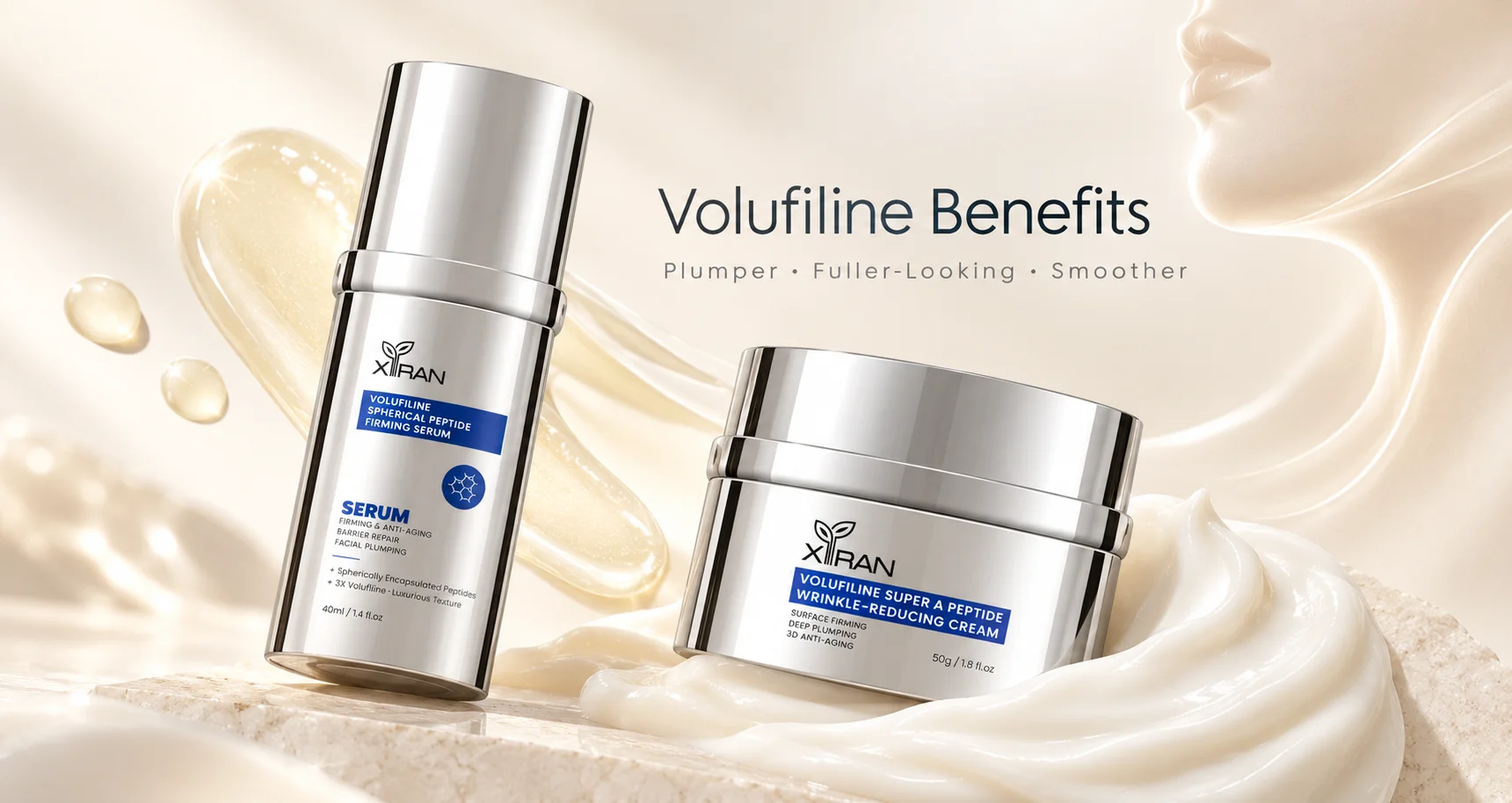
One example of this approach is our 5% Volufiline Peptide Anti-Wrinkle Cream, which combines Volufiline with multiple peptides, retinoid ingredients, ceramide and antioxidants rather than asking Volufiline to carry the entire anti-aging positioning by itself.
That multi-active approach is closer to how I prefer to think about product formulation.
The word plumping is already everywhere in skincare, but not every plumping formula works around the same concept.
Hyaluronic acid is perhaps the easiest comparison.
A hyaluronic-acid formula is generally developed around hydration and water retention. When skin is better hydrated, its surface may look smoother, softer and temporarily more plump.
Volufiline is positioned differently. Its supplier story centers on sarsasapogenin and adipose-related biological pathways rather than simply on water binding. That mechanism is interesting, but it is important not to confuse evidence about a biological pathway with proof of meaningful facial-volume restoration in humans. Research involving sarsasapogenin has examined its effects in adipocytes and adipose tissue, but this is not the same thing as demonstrating that a topical facial cosmetic produces filler-like volume changes.
That distinction is important for both consumers and brands.
If the concern is simply dehydrated skin, I would not automatically choose Volufiline over a strong moisturizing system.
If the product concept is specifically about fuller-looking skin and the appearance of facial volume, Volufiline becomes much more relevant.
And in many cases, there is no reason to choose one or the other. A formula can combine hydration-driven plumping from humectants with a Volufiline-led fuller-looking positioning.
That often produces a more complete skincare concept than expecting one active to do everything.
One reason Volufiline attracts so much attention is that consumers are not only thinking about wrinkles anymore. They are increasingly noticing the way certain facial areas can appear flatter or more hollow over time.
That is why Volufiline frequently appears in conversations around the cheeks and under-eye area.
I would still be careful about turning that interest into a structural claim.
For an eye-care product, for example, I am comfortable developing around concepts such as smoother-looking under-eyes, a more cushioned appearance and plumper-looking skin.
I would be much more cautious with phrases such as:
“restores lost under-eye fat”
or
“fills tear troughs.”
The first type of wording describes a cosmetic appearance benefit. The second begins to imply physical correction of underlying facial structure.
The difference becomes particularly important in a product such as a 5% Volufiline Peptide Plumping Eye Cream. In this type of formulation, Volufiline can sit alongside peptides, caffeine, hyaluronic acid and barrier-support ingredients to create a broader eye-care story without needing to claim that the product physically replaces lost fat.
One mistake brands sometimes make with trending ingredients is assuming that the hero ingredient needs to carry the entire product.
Volufiline does not need to do that.
In fact, one of the product combinations I find more interesting is Volufiline + peptides.
The two concepts are commercially complementary without being identical. Volufiline can sit on the plumping and fuller-looking side of the story, while an appropriate peptide system can support a broader positioning around firmness and smoother-looking skin.
That gives the finished product a clearer message:
Plumping + Firming + Smoothing
rather than simply:
“This product contains a high percentage of Volufiline.”
We use that type of multi-active logic in our 3% Volufiline Spherical Peptide Firming Serum, where Volufiline is combined with a peptide system, hyaluronic acid, retinoid ingredients and barrier-support components.
This is particularly relevant in serum development. A serum needs to do more than display an impressive number on the label. It also has to spread well, absorb comfortably, layer with the rest of a routine and remain stable throughout its intended shelf life.
A balanced Volufiline + peptide formula may therefore make more sense than simply pushing one ingredient as high as possible.
If concentration itself is what you are comparing, our separate guide to 3% vs 5% Volufiline explains why a higher number should not automatically be interpreted as a proportionally stronger finished product.
Volufiline does not need to sit only inside a “volume” formula.
A good anti-aging product usually needs to solve more than one visible concern. Skin that looks thin, flat or lined may also feel dry, uncomfortable or rough, which opens up useful formulation combinations with ingredients such as hyaluronic acid, squalane, ceramides, niacinamide and ectoin.
The logic here is not that these ingredients somehow “activate” Volufiline. I would avoid that kind of marketing language unless there were evidence for a specific interaction.
The advantage is simpler: each ingredient can contribute something different to the finished product.
Volufiline can support the plumping concept, humectants can support hydration, lipids and emollients can improve softness and barrier comfort, while selected peptides or other actives can broaden the firming and smoothing positioning.
This is usually how I prefer to develop a formula. Start with the result the consumer should understand, then build an ingredient system around that result rather than collecting trendy ingredients and inventing a story afterward.
This is probably the most important expectation to set.
Volufiline is sometimes described online as “filler in a bottle.” It is a memorable phrase, but scientifically it creates a comparison that should be treated with caution.
Dermal fillers are injected into tissue and physically alter volume. Volufiline is applied topically as one ingredient inside a cosmetic formulation.
Those are fundamentally different interventions.
This is also where cosmetic claim regulations become relevant. The FDA's guidance on cosmetic labeling claims states that cosmetic claims must be truthful and not misleading. In the United States, claims that a product is intended to affect the structure or function of the body can also change how the product is regulated.
The EU takes a similarly evidence-focused approach. Under Commission Regulation (EU) No 655/2013 on cosmetic claims, cosmetic claims should be supported by adequate and verifiable evidence, and ingredient properties should not simply be extrapolated to the finished product without appropriate substantiation.
For a beauty brand, claim wording therefore needs to be considered during product development—not after the formula and packaging have already been finalized.
This comparison helps explain Volufiline more clearly than simply listing more benefits.
Hyaluronic acid is primarily associated with hydration. By helping support water retention in the skin, a well-designed hyaluronic-acid formula can make the surface look temporarily smoother and more plump.
Volufiline has a different commercial positioning: the appearance of fullness and volume.
That means I would not necessarily position the two ingredients as competitors.

For a hydrating serum, hyaluronic acid may be the more obvious hero ingredient. For a product specifically built around facial fullness, Volufiline can offer a more distinctive direction. For a premium plumping formula, combining both can also make sense because they contribute to the product story in different ways.
The important point is that when consumers see the word “plumping,” they should understand what kind of plumping the brand is actually talking about.
This is one of the areas where ingredient articles can become too abstract.
Consumers do not apply “Volufiline” in isolation. They apply a serum, cream, eye cream or serum oil containing it.
Those formats create very different formulation opportunities.
| Product Type | Logical Volufiline Positioning |
|---|---|
| Volufiline Serum | Lightweight plumping, often paired with peptides or hydrating actives |
| Volufiline Eye Cream | Smoother-, firmer- and fuller-looking eye-area appearance |
| Volufiline Face Cream | Plumping combined with richer moisturization and barrier support |
| Volufiline Serum Oil | Plumping combined with nourishment and an emollient-rich skin feel |
For a serum, I usually prefer a broader active story because consumers expect concentrated treatment without an excessively heavy feel.
For a cream, there is more room to develop a richer emollient system and connect visible plumping with moisturization.
A serum oil presents another direction. Our 5% Volufiline Anti-Wrinkle Serum Oil, for example, combines Volufiline with squalane and multiple botanical oils, allowing the product to connect facial-plumping positioning with nourishment and a softer skin feel.
The correct format therefore depends on the consumer problem the product is meant to solve.
This is where credible skincare education becomes more useful than simply repeating marketing language.
I would not promise that a topical Volufiline cosmetic will permanently rebuild facial fat, restore anatomical volume loss, replace dermal filler or guarantee a specific percentage increase in facial volume unless the finished product has evidence that genuinely supports that exact claim.
The available research around Volufiline and sarsasapogenin is interesting, but laboratory, animal, supplier and finished-product human evidence should not be treated as interchangeable. For example, peer-reviewed sarsasapogenin research has examined adipocytes and adipose tissue in metabolic models; it does not establish filler-like cosmetic effects from applying a Volufiline serum to the human face.
At the same time, I do not think the correct response is to dismiss the ingredient completely.
Volufiline can still be an interesting cosmetic active for products built around visible plumping and fuller-looking skin. The key is keeping the claim proportional to the evidence.
For me, there is nothing unreasonable about saying:
“helps skin look plumper and fuller.”
There is a substantial difference between that and saying:
“regrows facial fat.”
That difference is where responsible product positioning begins.
I would be cautious about promising one universal timeline.
Many before-and-after posts online create the impression that Volufiline should produce dramatic changes in a few days. I would not use those examples as the basis for a product claim.
With any finished skincare product, visible results can be influenced by the complete formulation, frequency of application, skin condition and the specific benefit being measured. Hydration and skin-feel improvements may be noticed relatively quickly, while longer-term plumping or firming claims should be based on appropriate testing of the finished formulation.
For consumers, consistency is more useful than chasing dramatic overnight transformation.
For brands, the better approach is to test the actual product rather than borrowing a timeline from an ingredient study or a viral before-and-after image.
“Better” depends on what the product is supposed to do, but commercially I think the combination is very strong.
A Volufiline-focused concept can make sense when the brand wants the ingredient itself to dominate the product story. A Volufiline + peptide formula becomes more interesting when the desired positioning extends beyond plumping into firmness, smoother-looking texture and broader anti-aging care.
I would think of that product as an active system rather than asking which single ingredient deserves all the credit. Volufiline can support the fullness story, peptides can broaden the firming story, and appropriately selected moisturizing ingredients can improve both skin feel and the overall consumer experience.
That creates a more balanced formula and, in many cases, a more believable product proposition.
From a branding perspective, I would resist the temptation to put every possible Volufiline-related benefit on one package.
Products become easier to understand when they have a clear hierarchy.
A Volufiline Plumping Serum should primarily communicate fuller-, plumper-looking skin.
A Volufiline + Peptide Serum can move toward plumping plus firmness.
A Volufiline Eye Cream can focus on smoother- and fuller-looking eye contours.
A richer Volufiline Face Cream can connect plumping with moisture and mature-skin comfort.
Those are different product briefs even though they share the same hero ingredient.
If you are developing the ingredient commercially rather than simply researching it as a consumer, our guide to developing a Volufiline serum for a skincare brand goes deeper into concentration, formula format, supporting actives, samples and product positioning.
At Xiran Skincare, I would normally decide the benefit hierarchy before finalizing the active system, texture or packaging. Once we know whether the brand wants to own plumping, plumping + firming, eye-area smoothing or a broader premium anti-aging position, it becomes much easier to build a coherent formula.
This approach also helps prevent the product from becoming another formulation that simply follows ingredient trends without a clear reason to exist.
I think Volufiline is interesting, but the most useful version of its story is less dramatic than the one circulating on social media.
It is not necessary to describe Volufiline as a topical filler or promise permanent facial-fat growth for the ingredient to have commercial value.
Its more credible place in skincare is as a plumping-focused cosmetic ingredient that can be incorporated into products designed for fuller-, smoother- and more cushioned-looking skin. It becomes even more versatile when paired thoughtfully with peptides, humectants, barrier lipids and other supporting ingredients.
For consumers, that means setting realistic expectations.
For brands, it means seeing Volufiline as part of a formulation strategy rather than simply a percentage to print on the front of the bottle.
That is the approach I would take when developing a Volufiline serum, eye cream, facial cream or treatment oil: start with the visible benefit we want the customer to understand, build the formula around that goal, and make sure the claims never run further than the evidence.
Volufiline is mainly used in skincare for its plumping and fuller-looking skin positioning. It is particularly relevant to products designed around the appearance of facial fullness rather than basic hydration alone. The performance of the finished product still depends on its complete formulation rather than Volufiline by itself.
Volufiline is better described as a plumping-focused ingredient than as a standalone wrinkle treatment. A fuller, better-conditioned skin appearance may make some fine lines look less noticeable, particularly when Volufiline is combined with moisturizing, peptide or other supporting ingredients.
Volufiline can be incorporated into eye-care formulas developed around smoother- and fuller-looking skin, which is one reason the ingredient has become popular in this category. Claims that it restores lost under-eye fat or physically corrects tear troughs would require a much stronger level of evidence.
Yes. Volufiline and peptides can fit naturally within the same product concept. Volufiline can support plumping and fuller-looking positioning, while peptides can contribute to a broader firming and smoothing story. The actual combination should still be formulated and stability-tested as a complete product.
They are not direct substitutes. Hyaluronic acid is primarily valued for hydration and water-related plumping, while Volufiline is marketed around the appearance of fullness and volume. A formula may use either ingredient or combine them depending on its intended positioning.
Yes. Volufiline can be incorporated into private label and custom-developed serums, eye creams, facial creams and serum oils. For brands, I recommend deciding the target benefit, product format, supporting actives, claim direction and sensory profile before settling on the final concentration. XIRAN also supports custom formulation and product development through its skincare R&D and formulation laboratory.